Super Mario Games Guide: Where to Start and How the Series Fits Together
Mainline 2D Mario, 3D Mario and the spin-offs explained, with release history and the best entry points on Nintendo Switch and Switch 2.
Mario has starred in more than 200 games since 1981, which makes “where do I start?” a surprisingly difficult question. The good news is that the series is much easier to understand once you see it as a few separate branches rather than one long line. There are the mainline 2D platformers, the mainline 3D platformers, and a huge family of spin-offs that borrow Mario’s characters for racing, role-playing, sports and more. This guide maps those branches, explains what separates them, and points you to the best starting points on Nintendo Switch and Switch 2.
Mainline vs Spin-Off: The Distinction That Matters
When fans talk about “mainline” Mario, they usually mean the platform games that carry the Super Mario name and are built around running and jumping through levels to reach a goal or rescue Princess Peach. Nintendo’s own development teams make them, and each one tends to introduce a big new idea that shapes the series for years.
Spin-offs use the same cast in different genres. Mario Kart is a racing series, Paper Mario and Mario & Luigi are role-playing games, and there are tennis, golf, soccer and party games too. Some spin-offs, such as Luigi’s Mansion or Captain Toad: Treasure Tracker, give supporting characters their own adventures.
There is no story continuity you need to follow. Each mainline game is self-contained: Bowser causes trouble, Mario sets off to stop him. That means you can start anywhere without missing anything important, and the real question is simply which style of game appeals to you.
What Every Mainline Mario Has in Common
Although the 2D and 3D games look very different, they share a recognizable design philosophy that helps explain why the series has lasted so long:
- Movement comes first. Every mainline game is built around how good it feels to run and jump. Mario’s jump arc, his momentum and the way he lands are tuned carefully, and new abilities such as wall jumps, spin jumps and Cappy throws are layered on top.
- Teach through play. Mario games rarely explain things with long tutorials. The first level of Super Mario Bros. famously introduces Goombas, mushrooms and blocks through careful placement rather than text, and later games follow the same idea.
- Power-ups as personality. From the Fire Flower and Super Leaf to the Cat Suit and the Elephant Fruit, each game is defined partly by its signature transformation.
- One big new idea per game. Sunshine had F.L.U.D.D., Galaxy had gravity, Odyssey had Cappy and Wonder had Wonder Flowers. Knowing a game’s central gimmick is a good way to decide whether it will appeal to you.
The 2D Mainline Games
The 2D games are side-scrolling platformers. You move left to right through a level, jump on enemies, grab power-ups such as the Super Mushroom and Fire Flower, and reach the flagpole or goal at the end. Levels are short and replayable, which makes them great for younger players and for quick sessions.
| Year | Game | Original platform |
|---|---|---|
| 1985 | Super Mario Bros. | NES |
| 1986 | Super Mario Bros.: The Lost Levels (Japan) | Famicom Disk System |
| 1988 | Super Mario Bros. 2 (international) | NES |
| 1988 | Super Mario Bros. 3 (Japan; 1990 in North America) | NES |
| 1989 | Super Mario Land | Game Boy |
| 1990 | Super Mario World (Japan; 1991 in North America) | Super NES |
| 1992 | Super Mario Land 2: 6 Golden Coins | Game Boy |
| 2006 | New Super Mario Bros. | Nintendo DS |
| 2009 | New Super Mario Bros. Wii | Wii |
| 2012 | New Super Mario Bros. 2 and New Super Mario Bros. U | 3DS / Wii U |
| 2015 | Super Mario Maker | Wii U |
| 2019 | Super Mario Maker 2 | Switch |
| 2023 | Super Mario Bros. Wonder | Switch |
Super Mario Bros. Wonder (October 20, 2023) is widely regarded as the freshest 2D Mario in decades. Its Wonder Flowers transform levels in unpredictable ways, and its Badge system lets players customize abilities. On Switch 2, it received a Nintendo Switch 2 Edition + Meetup in Bellabel Park on March 26, 2026, which adds new multiplayer content and other extras for the new hardware.
The classic NES, Super NES and Game Boy entries are playable on Switch and Switch 2 through the Nintendo Classics libraries included with Nintendo Switch Online.
The 3D Mainline Games
The 3D games let you roam freely in three dimensions. Instead of a single route to a flagpole, you usually explore worlds and collect objects such as Power Stars or Power Moons. They demand more camera control and spatial awareness, but they also offer some of the most celebrated level design in gaming.
| Year | Game | Original platform |
|---|---|---|
| 1996 | Super Mario 64 | Nintendo 64 |
| 2002 | Super Mario Sunshine | GameCube |
| 2007 | Super Mario Galaxy | Wii |
| 2010 | Super Mario Galaxy 2 | Wii |
| 2011 | Super Mario 3D Land | 3DS |
| 2013 | Super Mario 3D World | Wii U |
| 2017 | Super Mario Odyssey | Switch |
| 2021 | Super Mario 3D World + Bowser’s Fury | Switch |
There are two broad styles within 3D Mario. The “open” games, such as Super Mario 64, Sunshine and Odyssey, drop you into large areas to explore in any order. The “course” games, such as 3D Land and 3D World, use more linear levels with a clear goal, blending 3D movement with the structure of 2D Mario. The Galaxy games sit between the two.
On Switch, Super Mario Galaxy + Super Mario Galaxy 2 arrived on October 2, 2025, giving the Wii classics a new home with improved resolution and interface tweaks; they also play on Switch 2. Super Mario 64 is available through the Nintendo 64 library in the Nintendo Switch Online + Expansion Pack tier. As of October 2026, Nintendo has not announced a brand-new mainline 3D Mario for Switch 2.
The Spin-Off Branches
Mario’s spin-offs are large enough that some have their own dedicated fans who never touch the platformers. The main branches are:
- Mario Kart (since Super Mario Kart in 1992): kart racing with items. Mario Kart 8 Deluxe on Switch and Mario Kart World, a launch game for Switch 2 in June 2025, are the current entries.
- Role-playing games: Super Mario RPG (1996, remade in 2023), Paper Mario (from 2000, with The Thousand-Year Door remade in 2024) and Mario & Luigi (from 2003, with Brothership released in 2024). These swap jumping through levels for turn-based battles and dialogue-heavy stories.
- Party games: Mario Party, a long-running board-game series.
- Sports: tennis, golf, soccer and Olympic-themed games. Mario Tennis Fever released on February 12, 2026 for Switch 2.
- Character spin-offs: Luigi’s Mansion, Captain Toad: Treasure Tracker, Princess Peach: Showtime!, the Yoshi series and the Wario series.
- Puzzle games: Dr. Mario and the Mario vs. Donkey Kong series, the latter remade for Switch in 2024.
Spin-offs are often the best way into Mario for people who do not enjoy platformers. Someone who prefers stories and menus may love Paper Mario; someone who wants a social game may start with Mario Kart.
Best Entry Points on Switch and Switch 2
For complete beginners and young children: Super Mario Bros. Wonder
Wonder is bright, inventive and very forgiving if you choose the right character. Yoshi and Nabbit do not take damage from enemies, which makes them ideal for young or nervous players, and levels are short enough to retry without frustration.
For players who want to explore: Super Mario Odyssey
Odyssey (October 27, 2017) is the best-known 3D Mario on Switch. Mario’s hat, Cappy, can capture enemies and objects, and the game’s many kingdoms are packed with Power Moons to find. An Assist Mode makes it more approachable. It received a free Switch 2 update with visual improvements and a two-player GameShare option.
For shorter, structured 3D levels: Super Mario 3D World + Bowser’s Fury
3D World’s compact courses suit people who find open 3D worlds overwhelming, and its levels support up to four players on one console. Bowser’s Fury, included in the same package, is a short open-world experiment that hints at where 3D Mario might go next.
For the history buff: Super Mario Galaxy + Super Mario Galaxy 2 and the Classics libraries
The Galaxy games are often ranked among the best platformers ever made, and the Nintendo Classics libraries let you trace the series back to its NES origins.
For non-platformer fans: Mario Kart World or Paper Mario: The Thousand-Year Door
One is a social racing game, the other a story-rich role-playing adventure, and neither requires platforming skill.
A Suggested Path Through the Series
If you want to play more than one game, a sensible order on modern hardware is:
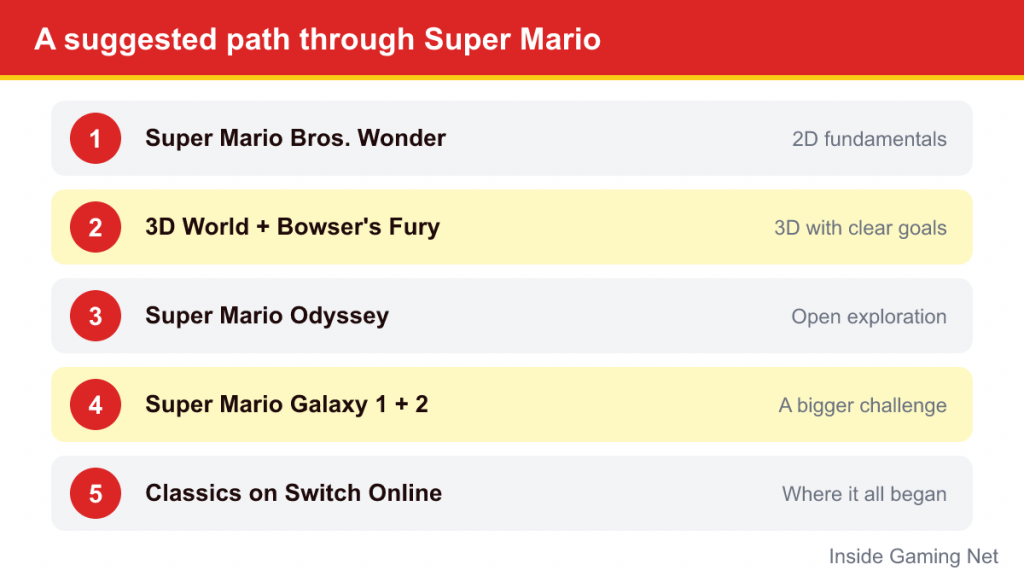
- Super Mario Bros. Wonder to learn the fundamentals of running, jumping and power-ups.
- Super Mario 3D World + Bowser’s Fury to get comfortable moving in 3D with clear objectives.
- Super Mario Odyssey for full open exploration.
- Super Mario Galaxy + Super Mario Galaxy 2 for a more challenging, creative take on 3D platforming.
- Classic entries such as Super Mario World and Super Mario 64 through Nintendo Switch Online, once you are curious about where it all began.
That order gradually raises the demands on camera control and precision, so the learning curve feels natural rather than steep.
Common Misconceptions
- “You need to play them in order.” You do not. Stories are simple and self-contained.
- “Mario games are just for kids.” The later worlds and post-game challenges in Odyssey, Galaxy and Wonder are demanding even for experienced players.
- “Spin-offs are lesser games.” Several spin-off series, notably Mario Kart and Paper Mario, are among Nintendo’s most acclaimed and best-selling titles in their own right.
- “Super Mario 3D All-Stars is the easy way to get the classics.” That 2020 collection was a limited-time release and is no longer sold digitally, so the current options are the individual Switch releases and Nintendo Switch Online.
Not sure which console you need for these games? Our Switch vs Switch 2 comparison explains what runs where, and our guide to Nintendo Switch Online plans covers the classic libraries in detail.