Donkey Kong Series Guide: From Arcade Rival to Bananza
How Donkey Kong went from arcade villain to platforming star, from Rare's Country trilogy and Retro's revival to Bananza on Switch 2, and where to start.
Few characters have changed jobs as often as Donkey Kong. He began as the barrel-hurling antagonist in a 1981 arcade game, became the star of some of the best-selling platformers of the 1990s, disappeared into spin-offs for years, was revived by an American studio in Texas, and in 2025 reinvented himself as a wall-smashing 3D hero on Nintendo Switch 2. This guide walks through the whole family tree and ends with advice on where to begin today.
The 1981 Arcade Game in Brief
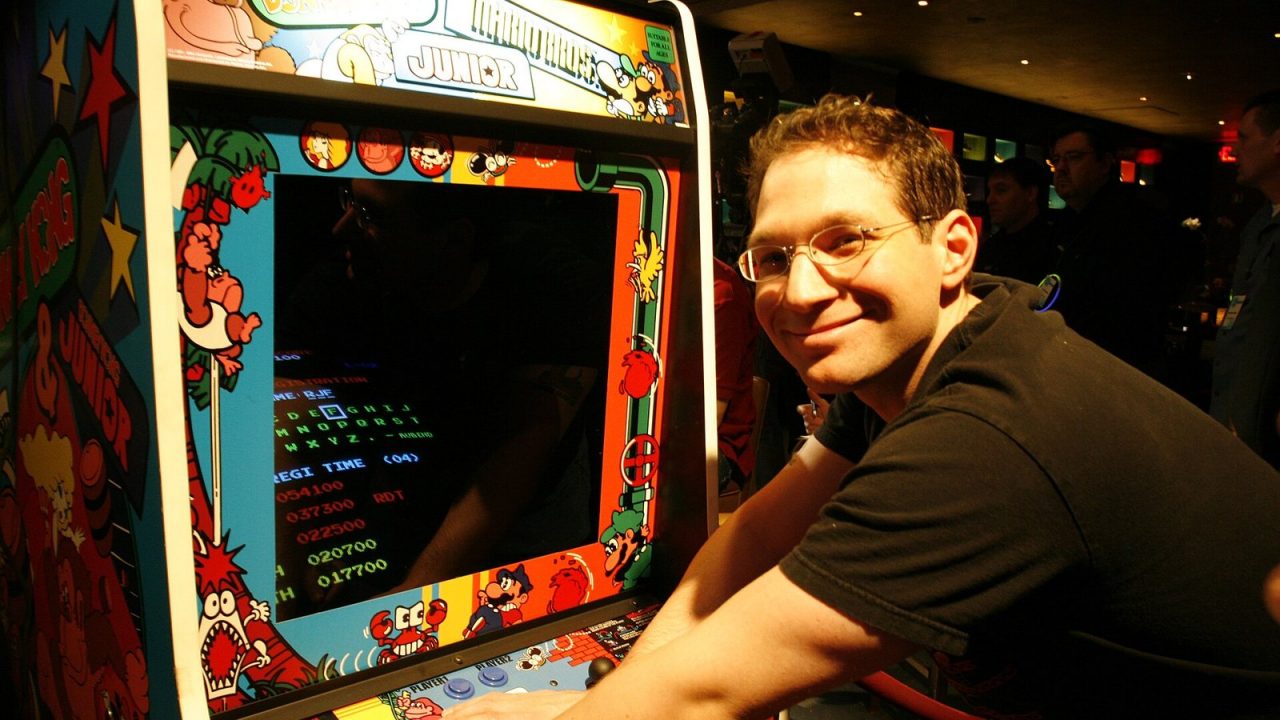
The original Donkey Kong arrived in arcades in July 1981. It was designed by Shigeru Miyamoto, and it became Nintendo’s first major international hit. The setup was simple: a giant ape carries a woman named Pauline to the top of a construction site, and a carpenter, originally called Jumpman and later renamed Mario, climbs ladders and jumps over rolling barrels to reach her.
That game matters to this guide for two reasons. First, it is one of the earliest games built around jumping as the core verb, which is why it sits at the root of the platformer family tree. Second, it introduced characters who keep returning: Mario obviously, but also Pauline, who plays a central role in Bananza more than four decades later. The arcade game was followed by Donkey Kong Jr. (1982), where the roles flipped and DK’s son had to rescue his caged father from Mario, and the shooter-style Donkey Kong 3 (1983).
A 1994 Game Boy game, also simply titled Donkey Kong, deserves a mention because it remade the original four stages and then added over 100 puzzle-platform levels. Its key-carrying puzzle design later became the foundation of the Mario vs. Donkey Kong series, which began on Game Boy Advance in 2004 and was remade for Switch in 2024.
Rare and the Donkey Kong Country Trilogy
The modern Donkey Kong was born in November 1994, when British developer Rare released Donkey Kong Country on the Super Nintendo. Led by brothers Tim and Chris Stamper, with gameplay design by Gregg Mayles and music by David Wise, Rare rebuilt DK as a heroic, tie-wearing jungle dweller on a quest to recover his stolen banana hoard from King K. Rool and the Kremlings.
Its pre-rendered graphics drew the headlines, but its design is what lasted:
- Tag-team Kongs. You control two characters, swapping between them; taking a hit loses your active partner rather than ending your run immediately.
- Rolling and momentum. DK’s roll attack and the ability to jump out of a roll gave the levels a fast, flowing rhythm.
- Barrel cannons. Launching from barrel to barrel became a signature set piece.
- Animal Buddies. Rideable allies such as Rambi the rhino and Enguarde the swordfish changed how you moved through a stage.
- Hidden bonus rooms and K-O-N-G letters. Secrets tucked into walls and off-screen corners rewarded curiosity.
The game sold 9.3 million copies, and Rare quickly followed it with Donkey Kong Country 2: Diddy’s Kong Quest (1995), which actually sidelined DK himself: he is kidnapped, and Diddy Kong teams up with Dixie Kong, whose ponytail helicopter spin made her an instant favorite. Donkey Kong Country 3: Dixie Kong’s Double Trouble! (1996) paired Dixie with the toddler Kiddy Kong and leaned further into an explorable overworld.
Donkey Kong 64
Rare took DK into 3D with Donkey Kong 64 in November 1999 on Nintendo 64, with music by Grant Kirkhope. It was a collectathon in the style of Rare’s own Banjo-Kazooie, with five playable Kongs, each with color-coded bananas and abilities. Its sheer volume of collectibles is still debated. It was the last major DK platformer for more than a decade, and Rare’s relationship with Nintendo ended when Microsoft acquired the studio in 2002.
The Wilderness Years and Jungle Beat
Between 1999 and 2010, Donkey Kong was busy but rarely starring in a traditional platformer. The most interesting experiment was Donkey Kong Jungle Beat (2004, GameCube), developed by Nintendo EAD Tokyo under director Yoshiaki Koizumi. It was played with the DK Bongos controller: drumming the left or right bongo moved DK, and clapping triggered actions. The Tokyo team behind it went on to build Super Mario Galaxy. That lineage matters, because Koizumi, by then a senior Nintendo executive, is credited with setting Nintendo’s 3D Mario team on the path to making Bananza two decades later.
Retro Studios Revives the Country Formula
The series’ second golden age came from Retro Studios, the Austin, Texas team best known for Metroid Prime. Donkey Kong Country Returns launched on Wii in November 2010 in North America, produced by Kensuke Tanabe. It brought back the side-scrolling structure of the Rare games with a sharper, more physical style.
Retro made a few notable changes. Diddy Kong rode on DK’s back and contributed a jetpack that extended jumps rather than acting as a separate character in single-player. In two-player co-op, a second player controlled Diddy. Rambi returned, while the famous mine cart and rocket barrel stages became some of the most demanding sequences in any Nintendo game of the period. Returns also included the Super Guide: after losing eight lives in one level, you could let a white “Super Kong” finish it for you, though he would not collect items on your behalf.
Donkey Kong Country: Tropical Freeze followed in February 2014 on Wii U and was ported to Switch in May 2018. It is widely regarded as one of the best 2D platformers Nintendo has published. Highlights include:
- Three partner Kongs: Diddy’s jetpack, Dixie’s ponytail hover and Cranky Kong’s cane bounce, which lets him safely pogo off spikes.
- Dynamic camera work that swings from side-on into dramatic 3D angles during set pieces.
- A returning David Wise soundtrack, which is frequently cited as a highlight.
- Funky Mode on Switch: an optional easier way to play as Funky Kong, who has extra hit points, a double jump and the ability to hover.
Tropical Freeze is hard, and critics were divided on its difficulty. For more context on how it compares with other side-scrollers, see our list of the best 2D platformers on Switch and Switch 2.
The original Returns came back too. Donkey Kong Country Returns HD, developed by Forever Entertainment, launched on Switch on January 16, 2025, and includes the extra content from the 3DS version. According to the game’s update history, a January 2026 update added Dixie Kong as a playable partner along with enhancements for Switch 2.
Donkey Kong Bananza: A New Kind of DK Game
Donkey Kong Bananza launched on July 17, 2025, as a Nintendo Switch 2 exclusive. It was developed by Nintendo EPD, the team behind Super Mario Odyssey, with Kenta Motokura as producer and Wataru Tanaka and Kazuya Takahashi as directors. It is the first fully 3D DK platformer since Donkey Kong 64, but it plays nothing like that game.
The defining idea is destruction. Donkey Kong can punch, dig and tear through nearly any surface, carving his own paths, uncovering hidden items and ripping out chunks of terrain to throw. Levels are built as a stack of underground layers, each with its own theme, and you descend toward the planet’s core. A bedrock layer limits how far down you can dig in each area, which keeps the freedom from becoming chaos.
Other key systems include:
- Bananza transformations. Five animal forms, Gorilla, Zebra, Ostrich, Elephant and Snake, each grant different abilities such as extra strength, speed, gliding, inhaling terrain or higher jumps, limited by an energy meter.
- Banandium Gems. The main collectible, spent on a skill tree to upgrade DK’s abilities.
- Pauline. The heroine from the 1981 arcade game returns as a young girl whose singing activates transformations. A second player can control her in co-op, firing projectiles to help DK.
Bananza scored 91 on Metacritic and won Best Family Game at The Game Awards 2025. Nintendo’s own sales data lists it at 4.78 million units worldwide as of June 30, 2026, placing it among the Switch 2’s top-selling titles. A paid expansion, DK Island & Emerald Rush, followed in September 2025. You can find it alongside other big 3D releases in our roundup of the best 3D platformers on Switch and Switch 2.
How the Series Fits Together
Donkey Kong’s history is easier to follow if you think in branches rather than one straight line.
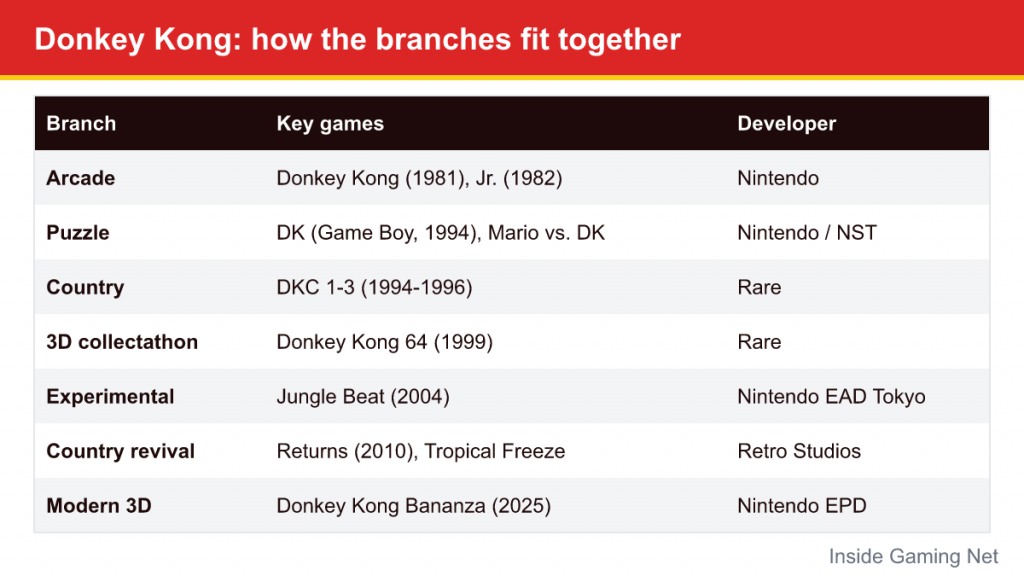
| Branch | Key games | Developer | Style |
|---|---|---|---|
| Arcade origins | Donkey Kong (1981), Donkey Kong Jr. (1982) | Nintendo | Single-screen climbing and jumping |
| Puzzle-platformers | Donkey Kong (Game Boy, 1994), Mario vs. Donkey Kong (2004 onward) | Nintendo / Nintendo Software Technology | Keys, switches and short puzzle stages |
| Country (Rare) | DKC 1–3 (1994–1996) | Rare | 2D side-scrolling with tag-team Kongs |
| 3D collectathon | Donkey Kong 64 (1999) | Rare | Large hub-based 3D worlds |
| Experimental | Donkey Kong Jungle Beat (2004) | Nintendo EAD Tokyo | Bongo-controlled action platforming |
| Country (Retro) | Returns (2010), Tropical Freeze (2014) | Retro Studios | Demanding 2D platforming with set pieces |
| Modern 3D | Donkey Kong Bananza (2025) | Nintendo EPD | Destructible 3D worlds and transformations |
The franchise also overlaps heavily with Mario: DK appears across Mario Kart, Mario sports games and the wider Mushroom Kingdom cast. If you want to see where those crossovers sit within Nintendo’s broader lineup, our Super Mario games guide maps the spin-off branches.
Where to Start Today
As of October 2026, the best Donkey Kong games are easy to reach on Nintendo hardware. Your starting point depends on what kind of player you are.
If you have a Switch 2 and want something modern
Start with Donkey Kong Bananza. It is the most approachable entry in years: the open layers let you explore at your own pace, and the destruction is satisfying even for players who struggle with precise jumps. Co-op with Pauline gives a younger or less experienced player a meaningful role without needing them to master DK’s moveset.
If you love classic 2D platforming
Play Donkey Kong Country: Tropical Freeze. It runs on both Switch and Switch 2 and is the series’ 2D peak. Newer or younger players should choose Funky Mode, which takes the edge off without changing the levels. If you finish it and want more of the same style, Donkey Kong Country Returns HD is the natural next step, though it is arguably even tougher in places.
If you want the Rare originals
The SNES trilogy has been available through Nintendo Switch Online’s Super Nintendo library, and Donkey Kong 64 finally joined the Expansion Pack’s Nintendo 64 library in June 2026, after years of fan requests. Check the current libraries on your system before subscribing, since classic catalogs can change.
If you prefer puzzles to reflexes
The 2024 Switch version of Mario vs. Donkey Kong is a slower, more thoughtful game, built on key-carrying and switch puzzles. It also includes a casual mode, which makes it a good fit for families.
What Makes a Donkey Kong Game Feel Like Donkey Kong
Across all these eras, DK is heavier than Mario: his jumps are weightier, his attacks are physical, and rolling and ground pounding have been part of his toolkit since the 1990s. Bananza essentially turns that physicality into the whole design.
The other constant is reinvention. Rare built something new around an arcade villain, Retro made the Country formula harder and more cinematic, and Nintendo EPD built a game around breaking the world apart. There is a good chance DK’s next game will look nothing like his last one.