Metroid Series Explained: 2D vs Prime and Where to Start
The Metroid series explained: Samus Aran, the 2D line through Metroid Dread, the first-person Prime games through Prime 4: Beyond, and the best entry points.

Metroid has never been Nintendo’s biggest seller, but few series have been as influential. Its blend of exploration, isolation and gradual power growth helped define an entire genre, and its first-person Prime games showed how that formula could work in 3D. The series is also split into two distinct styles that feel very different to play, which is the main thing newcomers need to understand. This guide introduces Samus Aran, explains the 2D and Prime lines, and recommends where to start on Switch and Switch 2.
Who Is Samus Aran?
Samus Aran is an intergalactic bounty hunter who wears a powerful Power Suit built by the bird-like Chozo, the ancient race that raised her. Across the series she battles Space Pirates, the parasitic Metroids that give the series its name, and recurring enemies such as the dragon-like Ridley and the shape-shifting X Parasites.

Samus is famous for a reveal at the end of the original 1986 game: players who finished it quickly enough discovered that the armored hero was a woman, a surprise that made her one of gaming’s earliest prominent female protagonists. Today she is one of Nintendo’s signature characters, though the series’ quiet, atmospheric tone is very different from Mario or Kirby.
What Makes a Metroid Game a Metroid Game
Every Metroid game shares a core structure:
- One large, interconnected world. Instead of separate levels, you explore a single map of linked rooms and regions.
- Ability gating. Many paths are blocked at first. Finding new abilities, such as the Morph Ball, missiles or the Grapple Beam, opens up areas you saw earlier but could not reach.
- Backtracking with purpose. Returning to old areas with new tools to uncover secrets is central to the experience.
- Atmosphere and isolation. Samus is usually alone on a hostile planet, and the series tells much of its story through environments rather than dialogue.
- Item collection. Hidden Missile Expansions and Energy Tanks reward careful exploration.
This design was so influential that it gave its name, along with Castlevania, to the “metroidvania” genre of exploration-based action platformers.
The 2D Line
The 2D Metroid games are side-scrolling action platformers. They are tightly designed, often fast-paced, and reward players who learn their maps well.
| Year | Game | Original platform |
|---|---|---|
| 1986 | Metroid | Famicom Disk System / NES |
| 1991 | Metroid II: Return of Samus | Game Boy |
| 1994 | Super Metroid | Super NES |
| 2002 | Metroid Fusion | Game Boy Advance |
| 2004 | Metroid: Zero Mission (remake of Metroid) | Game Boy Advance |
| 2017 | Metroid: Samus Returns (remake of Metroid II) | Nintendo 3DS |
| 2021 | Metroid Dread | Switch |
Super Metroid is the series’ most influential entry and still a benchmark for exploration design. Metroid Fusion introduced a more directed structure and a menacing pursuer called SA-X. Metroid Dread, released on October 8, 2021 and developed by MercurySteam with Nintendo, concludes the story arc that runs through the 2D games. It added the E.M.M.I., robotic hunters that chase Samus through specific zones, creating tense stealth-and-escape sequences.
The Prime Line
The Prime games, developed primarily by Nintendo’s Texas-based studio Retro Studios, move Metroid into first-person 3D. Despite the viewpoint, they are not traditional shooters. Combat matters, but the emphasis is on exploration, puzzle-solving and scanning the environment.
| Year | Game | Original platform |
|---|---|---|
| 2002 | Metroid Prime | GameCube |
| 2004 | Metroid Prime 2: Echoes | GameCube |
| 2007 | Metroid Prime 3: Corruption | Wii |
| 2023 | Metroid Prime Remastered | Switch |
| 2025 | Metroid Prime 4: Beyond | Switch / Switch 2 |
A defining Prime feature is the Scan Visor, which lets Samus analyze creatures, objects and ancient lore. Much of the story lives in these scans, so curious players are rewarded with a richer understanding of the world.
Metroid Prime Remastered, released on February 8, 2023, rebuilt the original Prime’s visuals for Switch and added modern twin-stick controls alongside other control options. Metroid Prime 4: Beyond launched on December 4, 2025 for Switch, with a Nintendo Switch 2 Edition that offers higher resolution and frame-rate modes. Its development had a famously long road: Nintendo announced the game in 2017, then publicly restarted development with Retro Studios in 2019. Nintendo said the game had sold more than one million copies across both systems by the end of 2025.
There are also spin-offs, such as Metroid Prime Hunters (DS), Metroid Prime Pinball and Metroid Prime: Federation Force (3DS), and the third-person Metroid: Other M (Wii), which is often considered the series’ most divisive entry.
How the Story Connects (Spoiler-Light)
Metroid’s story is simpler than its reputation suggests, and you can enjoy any game without knowing it. Still, a rough map helps.
In story order, the original Metroid (or its remake, Zero Mission) comes first: Samus travels to the planet Zebes to stop the Space Pirates from using Metroids as weapons. The Prime trilogy takes place between that first mission and Metroid II, following Samus as she confronts a corrupting substance called Phazon across several worlds. Metroid II (or Samus Returns) sends her to the Metroid home world, SR388, and its ending sets up Super Metroid. After that come Other M, Fusion and finally Dread, which closes the long-running arc involving the Metroids and the Chozo.
Metroid Prime 4: Beyond takes Samus to a new setting with its own self-contained mission, while returning fans will recognize familiar enemies and themes. The key point for newcomers is that each game re-explains what you need, and none of them expects you to have memorized the timeline.
2D vs Prime: Which Style Suits You?
| 2D Metroid | Metroid Prime | |
|---|---|---|
| Perspective | Side-scrolling | First-person 3D |
| Pace | Faster, more action-heavy | Slower, more methodical |
| Story delivery | Minimal, environmental | Environmental plus optional lore scans |
| Difficulty feel | Demanding bosses and reflex tests | Navigation and puzzle-solving, with tough bosses |
| Good for | Platformer and action fans | Players who enjoy immersive exploration |
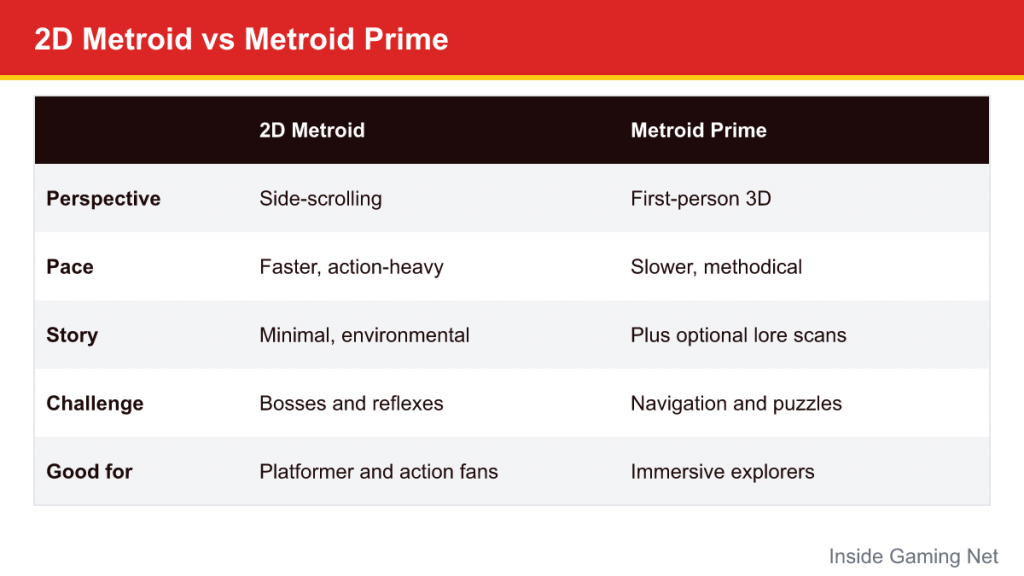
Neither line requires the other. They share Samus, enemies and lore, but each can be enjoyed independently.
Where to Start on Switch and Switch 2
Metroid Dread: best modern 2D entry
Dread is polished, fluid and gives the 2D formula modern controls and presentation. It is challenging, especially its bosses, but generous checkpoints help. Although it is the latest chapter in the 2D story, the game opens with a short recap, so newcomers can follow along.
Metroid Prime Remastered: best place to start the Prime line
The remaster is widely regarded as one of the finest remasters Nintendo has released, and the original Prime remains a superb introduction to 3D Metroid. Its modern control scheme removes most of the awkwardness of older first-person console controls.
Metroid Prime 4: Beyond: for the newest experience
If you want the latest game and own a Switch 2, Beyond is the most technically impressive entry. Reviews were generally positive, though some critics found its large overworld areas sparse, so players who prize dense level design might prefer to start with Remastered.
Super Metroid and Metroid Fusion via Nintendo Switch Online
Super Metroid is part of the Super NES library included with the standard membership, and Metroid Fusion is in the Game Boy Advance library with the Expansion Pack. Both are excellent if you enjoy Dread and want to see where its ideas came from.
Is Metroid Suitable for Kids?
Metroid is darker in tone than most Nintendo franchises, with alien creatures, sci-fi violence and some unsettling environments. In North America the main Prime games, including Metroid Prime 4: Beyond, are rated T for Teen by the ESRB, and Metroid Dread’s listing carries Animated Blood and Fantasy Violence descriptors. They are also more challenging than Mario or Kirby. That does not make them off-limits for a capable younger player, but parents should look at the rating and descriptors on the box or eShop page and decide based on their own child.
Tips for New Metroid Players
- Use the map constantly. Most progress in Metroid comes from noticing unexplored doors or blocked paths on the map.
- Remember obstacles you cannot pass. A wall you cannot break now may yield to a new weapon later.
- Experiment with new abilities. Each power-up usually has more than one use, including hidden ones.
- Do not be afraid to look things up. Getting stuck is part of the genre, but there is no shame in checking a hint if you are going in circles.
- Scan everything in Prime. Scans often reveal weak points and hidden routes, not just lore.
- Treat boss deaths as lessons. Metroid bosses, particularly in Dread, are built around patterns. Each attempt teaches you a little more, and the checkpoint usually sits right outside the arena.
- Go back for upgrades before tough fights. If a boss feels impossible, a few extra Energy Tanks or Missile Expansions found by exploring can make a real difference.
Common Misconceptions
- “Metroid Prime is a shooter.” It is first-person and you do shoot, but the heart of the game is exploration and puzzle-solving. Players who dislike competitive shooters often enjoy it.
- “You must play the games in order.” No game requires earlier ones. Recaps and self-contained plots make each entry approachable.
- “Metroid is a Castlevania spin-off,” or vice versa. The two series are unrelated. They share the “metroidvania” label because both popularized similar exploration structures, not because of any official connection.
- “The series is only for hardcore players.” Some entries are demanding, but generous checkpoints, maps and remastered controls make modern Metroid far more approachable than its 1980s origins.
For hardware context, see our Switch vs Switch 2 comparison. If you want to explore the series’ classic entries, our Nintendo Switch Online plans guide explains which membership includes which libraries.