Kirby Games Guide: The Series Explained and Where to Start
HAL Laboratory's Kirby series explained: Game Boy origins, Copy Abilities, 2D games vs Forgotten Land's 3D take, spin-offs and the best games to start with.
Kirby is one of Nintendo’s most approachable characters, a round pink hero who floats, inhales enemies and copies their powers. Behind that cute exterior is a series with more than three decades of history, a reputation for being easy to pick up and hard to fully master, and surprisingly intense final bosses. This guide explains where Kirby came from, how the series’ central mechanic works, how the 2D and 3D games differ, which spin-offs are worth knowing about and which games make the best starting point today.
Who Makes Kirby?
Kirby is developed by HAL Laboratory, a Japanese studio with a long relationship with Nintendo, and published by Nintendo. The character was created by Masahiro Sakurai, who later became famous as the director of the Super Smash Bros. series. HAL has handled the mainline Kirby games ever since, which helps explain the series’ consistency in tone and feel.
From the beginning, Kirby was designed to be welcoming to inexperienced players. The first game let Kirby float indefinitely by puffing up, which meant falling into pits, the classic platformer frustration, was much less of a threat. That philosophy of accessible basics with optional depth has guided the series ever since.
Kirby’s World and Recurring Characters
Most Kirby games are set on Planet Popstar, usually in the peaceful land of Dream Land, though recent adventures have taken Kirby to other worlds, including the overgrown “new world” of Forgotten Land. A small cast returns again and again:
- King Dedede, the self-proclaimed king of Dream Land. He starts as a greedy rival who steals food but is frequently an ally, or a victim of a bigger threat, in later games.
- Meta Knight, a masked swordsman with bat-like wings who acts as a rival, mentor and occasional antagonist.
- Bandana Waddle Dee, a spear-wielding friend who often serves as the second player’s character in co-op.
- Magolor, a traveler from another dimension who plays a central role in Return to Dream Land.
Stories are light and usually told without much dialogue: something threatens Dream Land, Kirby sets off to fix it. The twist comes at the end, where many games reveal a far more powerful hidden villain, often with an unexpectedly dramatic final battle and soundtrack. That contrast between sweet presentation and epic finales is one of the series’ trademarks.
Origins: Kirby’s Dream Land and Kirby’s Adventure
Kirby’s Dream Land debuted on the Game Boy in Japan in April 1992. It was short and simple by design, with Kirby inhaling enemies and spitting them out as projectiles. Because the original Game Boy screen was monochrome, many players outside Japan did not discover that Kirby was pink until later artwork and games.
The series’ defining feature arrived with Kirby’s Adventure on the NES in 1993: Copy Abilities. Instead of only spitting out swallowed enemies, Kirby could now absorb their powers. Swallow a sword-wielding foe and Kirby gains a sword; swallow a fire-breathing one and Kirby breathes fire. That one idea turned a simple platformer into a playground of different playstyles, and it has appeared in nearly every mainline game since.
How Copy Abilities Work
The basic loop is easy to grasp:
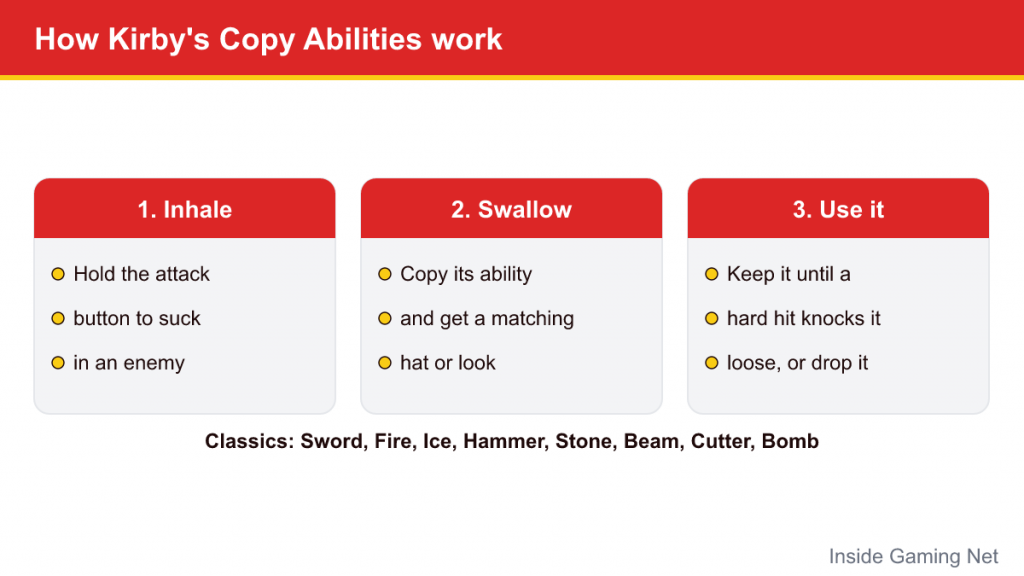
- Inhale an enemy by holding the attack button.
- Swallow it. If the enemy has an ability, Kirby copies it and gains a matching hat or look.
- Use the new moves until you take a hit hard enough to knock the ability loose, or discard it voluntarily to choose another.
Iconic abilities include Sword, Fire, Ice, Hammer, Stone (which turns Kirby into an invulnerable rock), Beam, Cutter and Bomb. Later games added more elaborate options, and some abilities grew huge move lists. Kirby Super Star (Super NES, 1996) gave each ability a full set of moves and allowed Kirby to turn an ability into a computer-controlled helper, letting a second player jump in.
Different games have built on the concept in their own ways. Kirby 64 let players combine two abilities into new hybrids, and recent games such as Kirby and the Forgotten Land let players evolve abilities into stronger versions.
The 2D Mainline Games
For most of its history Kirby has been a 2D side-scrolling platformer. Highlights include:
| Year | Game | Platform |
|---|---|---|
| 1992 | Kirby’s Dream Land | Game Boy |
| 1993 | Kirby’s Adventure | NES |
| 1996 | Kirby Super Star | Super NES |
| 2000 | Kirby 64: The Crystal Shards | Nintendo 64 |
| 2002 | Kirby: Nightmare in Dream Land | Game Boy Advance |
| 2004 | Kirby & The Amazing Mirror | Game Boy Advance |
| 2011 | Kirby’s Return to Dream Land | Wii |
| 2014 | Kirby: Triple Deluxe | Nintendo 3DS |
| 2016 | Kirby: Planet Robobot | Nintendo 3DS |
| 2018 | Kirby Star Allies | Switch |
| 2023 | Kirby’s Return to Dream Land Deluxe | Switch |
These games share a pattern: the main path is gentle, but collectibles, extra modes and post-game content provide real challenge. Many end with an unlockable extra mode or a hard boss rush that surprises players who assumed Kirby was purely a children’s series.
The Shift to 3D: Kirby and the Forgotten Land
Kirby and the Forgotten Land, released on Switch on March 25, 2022, was the first mainline Kirby built as a full 3D platformer. Set in a mysterious, overgrown post-apocalyptic world of abandoned cities and shopping malls, it kept Copy Abilities but adapted them for three-dimensional levels.
Its headline new feature was Mouthful Mode, in which Kirby stretches around large objects instead of swallowing them. Kirby can become a car, a vending machine, a traffic cone and many other objects, each used to solve puzzles or traverse levels. The game also introduced ability evolutions through blueprints, letting players upgrade their favorite powers.
Forgotten Land uses a level-based structure rather than an open world, with each stage containing hidden Waddle Dees to rescue. That structure makes it more approachable than many 3D platformers, while optional challenges keep completionists busy.
On August 28, 2025, Nintendo released Kirby and the Forgotten Land – Nintendo Switch 2 Edition + Star-Crossed World. It improves the visuals and frame rate on Switch 2 and adds a new story, Star-Crossed World. Owners of the original can buy an upgrade pack rather than the full game.
Notable Spin-Offs
HAL and Nintendo have used Kirby for a wide range of experiments. A few worth knowing:
- Kirby’s Dream Course (Super NES): a golf-like puzzle game.
- Kirby Air Ride (GameCube, 2003) and Kirby Air Riders (Switch 2, November 20, 2025): racing and vehicle battle games, with the latter directed by Sakurai.
- Kirby: Canvas Curse (DS) and Kirby and the Rainbow Curse (Wii U): Kirby rolls along lines the player draws.
- Kirby’s Epic Yarn (Wii) and its 3DS remake: a gentle game in a yarn art style, in which Kirby cannot really lose.
- Kirby Fighters and Kirby’s Dream Buffet: smaller multiplayer-focused downloadable titles.
These spin-offs vary in quality and depth, but they show how flexible the character is. For new players, though, the mainline platformers remain the best place to start.
Where to Start Today
Kirby and the Forgotten Land (or its Switch 2 Edition)
The best all-round introduction. It looks great, plays smoothly, uses a clear level structure and offers optional two-player co-op, with the second player controlling Bandana Waddle Dee. If you have a Switch 2, the Switch 2 Edition with Star-Crossed World is the definitive version.
Kirby’s Return to Dream Land Deluxe
The best 2D Kirby on Switch. It supports up to four players on one console, includes the extra minigame collection Merry Magoland, and adds a new epilogue called Magolor Epilogue. Its classic 2D structure is ideal for younger players and families.
Kirby Star Allies
A relaxed 2D game centered on recruiting enemies as helpers and combining abilities, such as adding fire to a sword. It is the easiest of the modern mainline games.
Classic games through Nintendo Switch Online
Kirby’s Adventure and Kirby’s Dream Land are available in the Nintendo Classics libraries, and several later classics appear in the higher-tier Expansion Pack libraries. They are a good way to see where the series’ ideas began.
Is Kirby Good for Young Children?
Kirby games are often recommended for children, and with good reason. Kirby can float over most hazards, health is generous and the main paths rarely demand precise timing. Co-op modes let a parent or older sibling help out.
That said, check the ratings. In North America, Kirby and the Forgotten Land and Kirby’s Return to Dream Land Deluxe are both rated E10+ by the ESRB, with fantasy or cartoon violence listed as the descriptor; the deluxe game also notes in-game purchases. Some final bosses are visually intense and use darker imagery than the rest of the game. Ratings are guidance rather than rules, so parents should decide based on their own child, perhaps by watching a little gameplay together first.
Common Misconceptions
- “Kirby is too easy for adults.” The main story is gentle, but extra modes, hard boss rushes and full completion can challenge experienced players.
- “Kirby is part of the Mario series.” Kirby is his own franchise, made by HAL Laboratory, and has his own world, Planet Popstar, and cast, including King Dedede and Meta Knight.
- “All Kirby games use Copy Abilities.” Most mainline games do, but several spin-offs, such as Epic Yarn and the Canvas Curse games, work differently.
If you are choosing between consoles for the newest Kirby releases, see our Switch vs Switch 2 comparison, and for the classic games, our Nintendo Switch Online guide explains which tier you need.