The Legend of Zelda Games in Order: Release Order and Timeline Explained
Every mainline Zelda game in release order, the official three-way timeline split after Ocarina of Time, and the best Zelda games to start with today.
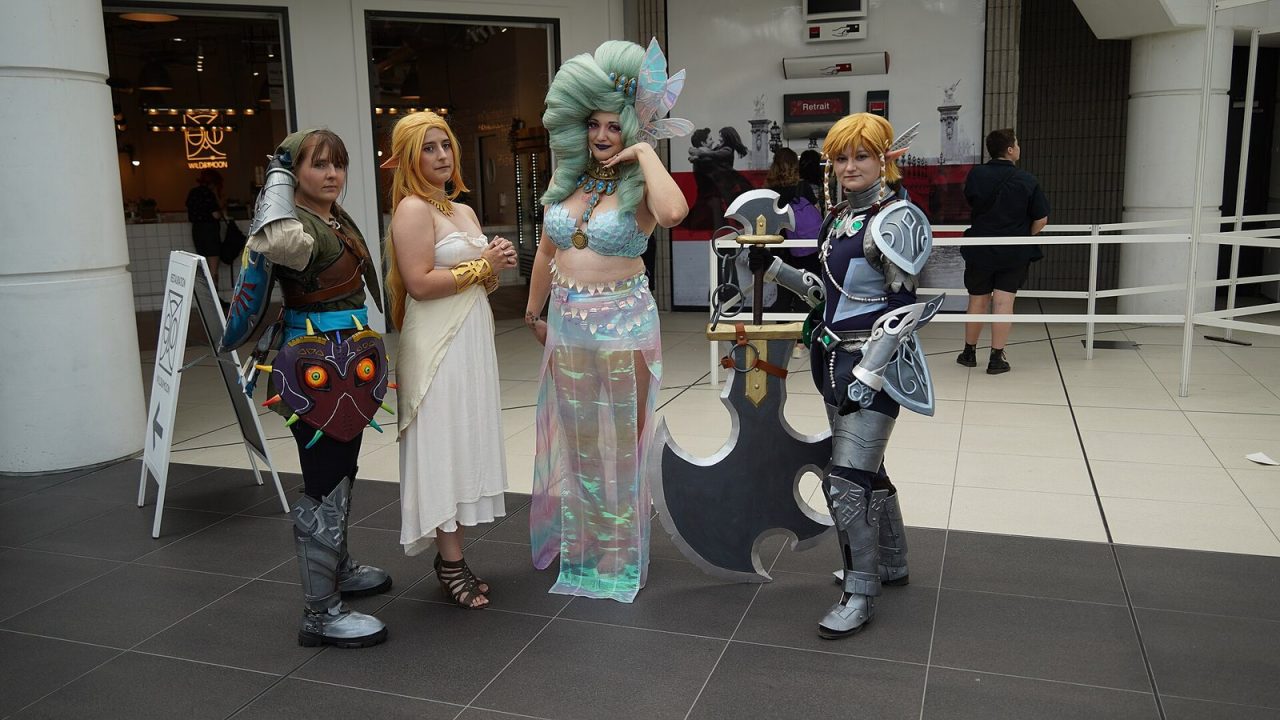
The Legend of Zelda turned 40 in 2026, and across those four decades it has built one of the most discussed fictional histories in gaming. Most entries star a hero named Link, a princess named Zelda and a recurring villain, usually Ganon or Ganondorf, yet they are rarely the same people from game to game. Nintendo eventually published an official timeline that explains how the games connect, and it is more complicated than most fans expected. This guide lists every mainline Zelda in release order, explains the timeline in plain language and recommends where to begin.
Release Order: Every Mainline Zelda
Dates below use each game’s first release. Remakes and remasters are listed separately afterward.
| Year | Game | Original platform |
|---|---|---|
| 1986 | The Legend of Zelda | Famicom Disk System / NES |
| 1987 | Zelda II: The Adventure of Link | Famicom Disk System / NES |
| 1991 | A Link to the Past | Super NES |
| 1993 | Link’s Awakening | Game Boy |
| 1998 | Ocarina of Time | Nintendo 64 |
| 2000 | Majora’s Mask | Nintendo 64 |
| 2001 | Oracle of Seasons and Oracle of Ages | Game Boy Color |
| 2002 | Four Swords (with A Link to the Past re-release) | Game Boy Advance |
| 2002 | The Wind Waker | GameCube |
| 2004 | Four Swords Adventures | GameCube |
| 2004 | The Minish Cap | Game Boy Advance |
| 2006 | Twilight Princess | GameCube / Wii |
| 2007 | Phantom Hourglass | Nintendo DS |
| 2009 | Spirit Tracks | Nintendo DS |
| 2011 | Skyward Sword | Wii |
| 2013 | A Link Between Worlds | Nintendo 3DS |
| 2015 | Tri Force Heroes | Nintendo 3DS |
| 2017 | Breath of the Wild | Wii U / Switch |
| 2023 | Tears of the Kingdom | Switch |
| 2024 | Echoes of Wisdom | Switch |
Remakes and remasters worth knowing
- Ocarina of Time 3D (3DS, 2011) and Majora’s Mask 3D (3DS, 2015).
- The Wind Waker HD (Wii U, 2013) and Twilight Princess HD (Wii U, 2016).
- Link’s Awakening (Switch, 2019), a full remake with a toy-like art style.
- Skyward Sword HD (Switch, 2021), with optional button controls in place of motion controls.
- Breath of the Wild and Tears of the Kingdom – Nintendo Switch 2 Editions (2025), with improved performance and extra features.
- Ocarina of Time for Nintendo Switch 2, a new remake revealed in June 2026 and scheduled, as of October 2026, for release on November 5, 2026.
The Official Timeline: Why There Are Three Branches
For years Nintendo avoided committing to a single chronology. That changed with Hyrule Historia, an official book released in Japan in 2011 for the series’ 25th anniversary, later published in English. It laid out a timeline that begins with Skyward Sword and then splits into three branches at the end of Ocarina of Time.
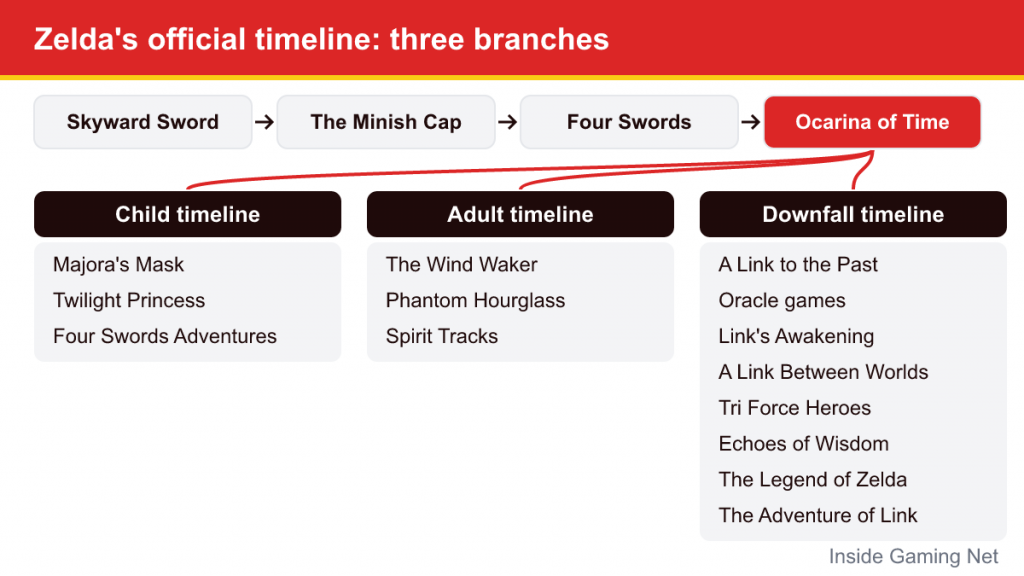
Before the split
The earliest games in the chronology are Skyward Sword, which tells the origin of the Master Sword and the recurring conflict, followed by The Minish Cap, Four Swords and finally Ocarina of Time.
Why it splits
At the end of Ocarina of Time, Link travels between his childhood and adulthood using the Master Sword. Hyrule Historia treats the ending as creating separate outcomes, plus a third possibility that the game never shows: what happens if Link loses.
Branch 1: The Child Timeline
After defeating Ganondorf, Link is sent back to his childhood and warns the royal family. This branch continues with Majora’s Mask, then Twilight Princess, then Four Swords Adventures.
Branch 2: The Adult Timeline
In the future Link leaves behind, Hyrule has no hero. Ganon eventually returns and the gods flood the kingdom. This branch contains The Wind Waker, Phantom Hourglass and Spirit Tracks, set on the seas above a drowned Hyrule and later a new land.
Branch 3: The Downfall Timeline
This branch imagines Link being defeated in Ocarina of Time. Ganon takes the Triforce and is sealed away, setting up the “Imprisoning War.” Including games added in later official material, it contains A Link to the Past, the Oracle games, Link’s Awakening, A Link Between Worlds, Tri Force Heroes, and finally the original The Legend of Zelda and The Adventure of Link.
When Echoes of Wisdom released in September 2024, Nintendo later placed it on the official timeline in the Downfall branch, after Tri Force Heroes and before the original The Legend of Zelda. That placement was announced through Nintendo’s official Zelda channels in late November 2024.
Where Breath of the Wild and Tears of the Kingdom Fit
Breath of the Wild and Tears of the Kingdom are the two “open-air” Zelda games, and they are deliberately vague about where they sit. Nintendo has said Breath of the Wild takes place far in the future, after the events of the other games, but it has not tied it to a specific branch. In-game references nod to locations and legends from all three timelines, which is part of why fans debate the question endlessly.
Tears of the Kingdom is a direct sequel to Breath of the Wild and features the same versions of Link and Zelda. Its story revisits the founding of Hyrule, which adds another layer to the debate without resolving it.
The practical takeaway: you do not need to know the timeline to enjoy either game. They were designed to be approachable to newcomers.
Does Story Order Matter When Playing?
Mostly no. Each Zelda game tells a self-contained story with its own Link and Zelda. Only a handful of direct sequels share characters:
- Ocarina of Time → Majora’s Mask (same Link).
- The Wind Waker → Phantom Hourglass (same Link), with Spirit Tracks set a century later.
- A Link to the Past → A Link Between Worlds (same world, generations apart).
- Breath of the Wild → Tears of the Kingdom (same Link and Zelda).
For those pairs, playing the first game first is worthwhile. Everywhere else, release order or simple personal interest is a perfectly good guide, and following the timeline strictly would mean starting with a motion-controlled game (Skyward Sword) and finishing with two difficult NES titles, which is not a beginner-friendly route.
Best Zelda Games to Start With Today
Breath of the Wild
The most common recommendation for new players. You can go almost anywhere from the start, solve problems in creative ways and set your own pace. It plays on Switch, and the Switch 2 Edition improves resolution and frame rate.
Tears of the Kingdom
A larger, more complex follow-up with building mechanics. You can start here, but playing Breath of the Wild first lets you appreciate how the world has changed.
Link’s Awakening (2019)
A compact, charming top-down adventure that is ideal for younger players or anyone who prefers a shorter, more structured game.
Echoes of Wisdom
Zelda herself is the playable lead, solving problems by copying objects and creatures as “echoes.” It is approachable and creative, and a good choice for players who enjoy puzzles more than combat.
Skyward Sword HD
A good pick if you are curious about the start of the chronology. The Switch version offers both motion and button controls.
Classic games via Nintendo Switch Online
The NES, Super NES, Game Boy, Nintendo 64 and Game Boy Advance libraries include several classic Zelda games, and The Wind Waker is part of the GameCube library on Switch 2 with the Expansion Pack. The tier you need depends on the console each game came from.
2D vs 3D Zelda: A Quick Primer
Zelda games come in two main styles. The top-down games, from the original through A Link to the Past, Link’s Awakening, A Link Between Worlds and Echoes of Wisdom, show Hyrule from above and emphasize tight dungeons and item-based puzzles. The 3D games, starting with Ocarina of Time, introduced the lock-on targeting system known as Z-targeting and grander, cinematic dungeons. Breath of the Wild and Tears of the Kingdom reshaped the 3D formula by replacing traditional item progression with physics-driven systems and an open world.
If you enjoy puzzle-dense, structured adventures, start with a top-down game. If you prefer freedom and exploration, start with Breath of the Wild.
Common Mistakes When Starting the Series
- Starting with the NES originals. The Legend of Zelda and The Adventure of Link are historically important but cryptic and demanding by modern standards. They are best enjoyed after a newer entry has hooked you, ideally with the rewind and suspend features in the Nintendo Classics apps.
- Treating the timeline as required reading. It is a fun puzzle for fans, not a prerequisite. No game assumes you know it.
- Rushing Breath of the Wild’s main quest. Its story is told in fragments you uncover by exploring. Heading straight for the final battle is possible, but you will miss most of what makes the game special.
- Expecting traditional dungeons in the open-air games. Breath of the Wild replaced classic dungeons with Divine Beasts and many small shrines; Tears of the Kingdom brings back larger themed dungeons, but both differ from older entries. If you want classic item-based dungeons, a top-down game such as Link’s Awakening is a better fit.
- Skipping Majora’s Mask because it is “weird.” Its three-day time loop is unusual, but it is one of the most distinctive games in the series once you understand that resetting time is part of the design.
Common Questions
Is Link the same person in every game?
No. Most games feature a new incarnation of Link, connected by the legend of the hero rather than by family or memory.
Is Zelda the main character?
Princess Zelda appears in nearly every entry, but Link is usually the player character. Echoes of Wisdom is the first mainline game where Zelda is the primary playable protagonist.
Do I need to read Hyrule Historia?
Not at all. It is a fun companion for fans, but the games are designed to be enjoyed on their own.
If you are deciding which Nintendo console to play these on, our Switch vs Switch 2 comparison explains which versions run where, and our Nintendo Switch Online guide covers the classic libraries.