What Is a Platformer? 2D vs 3D Platform Games Explained
What makes a game a platformer? The genre defined, 2D vs 3D design, sub-types from collectathons to precision platformers, and the landmark games behind each.
Few genres are as instantly recognizable as the platformer. A character runs, jumps across gaps, lands on ledges and avoids hazards on the way to a goal. Yet the label covers an enormous range of games, from bite-sized side-scrolling levels to sprawling 3D worlds and punishing challenges built around split-second timing. This guide defines the platform genre, explains how 2D and 3D platformers differ in design, walks through the main sub-types, and highlights the landmark games that shaped each one.
A Working Definition
A platformer is a game in which moving through space, especially jumping, is the main challenge. The name comes from the platforms, the surfaces the player character stands on, jumps between and sometimes rides. Fighting enemies, solving puzzles and collecting items are common, but they sit on top of a foundation of traversal.
A useful test is to ask what you spend most of your time doing. If it is judging distances, timing jumps and learning how a character moves, you are probably playing a platformer. If jumping is occasional and the focus is shooting, fighting or managing stats, the game belongs to another genre that happens to include jumping.
Platformers usually share a few traits:
- A carefully tuned movement set. How high, far and fast the character jumps defines the whole game.
- Hazards that punish mistakes. Pits, spikes and enemies test your control.
- Level design that teaches. Good platformers introduce an idea safely, then combine it with others in harder ways.
- Clear goals. Reach the flag, find the star, clear the screen or unlock the next area.
Where the Genre Came From
Early arcade games laid the groundwork. Space Panic (1980) is sometimes cited as an early platform game, though its hero climbed ladders without jumping. Donkey Kong (1981) is widely considered the first true platformer to let players jump over obstacles and gaps, and it introduced the character who would become Mario. Jump Bug (1981) added scrolling, and Namco’s Pac-Land (1984) was an early horizontally scrolling platformer.
Super Mario Bros. (1985) became the genre’s template. Its scrolling world, power-ups, hidden secrets and finely tuned momentum shaped thousands of games that followed. Through the late 1980s and early 1990s, platformers dominated home consoles, and nearly every publisher wanted its own mascot hero.
The jump to 3D followed in the 1990s. Jumping Flash! (1995) is often remembered as one of the first 3D platformers on a home console, and Super Mario 64 (1996) set the standard with open, explorable levels built around analog-stick movement.
After a boom in the late 1990s, platformers lost market share in the 2000s as other genres grew. The genre recovered through a combination of Nintendo’s continued investment, including New Super Mario Bros. in 2006, and an explosion of independent developers who revived 2D design in the late 2000s and 2010s.
2D Platformers: Precision on a Plane
In a 2D platformer, the action happens on a flat plane viewed from the side. You can move left, right, up and down, but not toward or away from the camera.
That limitation is also a strength. Because everything is visible on one plane, players can judge distances precisely, and designers can build tightly timed challenges. 2D levels tend to be linear and quick to replay, which makes them ideal for learning through repetition.
Key design traits of 2D platformers:
- Readability: hazards and paths are easy to see at a glance.
- Tight, consistent physics: players can make exact jumps because the rules never change.
- Short loops: a level can often be finished in a few minutes, with instant retries.
Landmark examples include Super Mario Bros. 3, Super Mario World, Sonic the Hedgehog, the Donkey Kong Country series, Rayman, Celeste and Super Mario Bros. Wonder.
Many modern “2D” games use 3D graphics while keeping gameplay on a single plane. These are often called 2.5D platformers. Donkey Kong Country: Tropical Freeze and Yoshi’s Crafted World are good examples.
3D Platformers: Freedom and the Camera Problem
A 3D platformer lets the character move in all directions through a three-dimensional space. That brings a sense of exploration and scale that 2D games cannot match, but it creates new design challenges.
The biggest is depth perception. On a flat screen it can be hard to judge exactly where a character will land. Designers use tools such as drop shadows directly under the character, clear platform outlines and generous landing zones to compensate. The camera is the other major challenge: it has to show the player what they need to see without getting stuck behind walls. Super Mario 64 framed its camera as a character, the Lakitu Bros., filming Mario’s adventure.
3D platformers tend to follow one of two structures:
- Open sandbox levels, where you explore a large area and complete many small objectives in any order. Super Mario 64, Super Mario Odyssey and Donkey Kong Bananza use this approach.
- Linear courses, with a clear path from start to goal. Super Mario 3D Land, Super Mario 3D World and Crash Bandicoot follow this model, which is often easier for beginners.
The Main Sub-Types
Collectathons
A collectathon is a 3D platformer in which progress depends on gathering items scattered through hub-connected worlds. After Super Mario 64, games like Banjo-Kazooie and Spyro the Dragon borrowed its format and helped define the style, which is why late-1990s console libraries are full of them. Modern examples include A Hat in Time and, in many respects, Super Mario Odyssey with its hundreds of Power Moons.
Precision platformers
Precision platformers focus on difficult, exact movement. Levels are usually short, deaths are frequent and respawns are instant, so players can try a tough section again and again until they master it. Super Meat Boy and Celeste are the best-known modern examples. Celeste also popularized flexible accessibility features through its Assist Mode.
Puzzle-platformers
These use platforming mechanics primarily to pose puzzles, such as manipulating time, moving blocks or switching characters. Braid and Captain Toad: Treasure Tracker are well-known examples; in the latter, Toad cannot jump at all, and the game focuses on navigating compact diorama-like stages.
Metroidvanias
Named after Metroid and Castlevania, metroidvanias are platform-adventure games built around a single interconnected map. New abilities let you reach areas you could not access before. Super Metroid, Castlevania: Symphony of the Night, Hollow Knight and Metroid Dread are landmarks.
Cinematic platformers
Cinematic platformers emphasize realistic, animation-driven movement and often minimal on-screen information. The original Prince of Persia is the classic example, and later games such as Limbo and Inside drew on the tradition.
Run-and-gun platformers
These combine platforming with constant shooting, as in Contra and Cuphead. Platforming is present but shooting often dominates.
Auto-runners
The character runs automatically and the player only controls jumps and other actions. The style is especially common on mobile devices.
2D vs 3D at a Glance
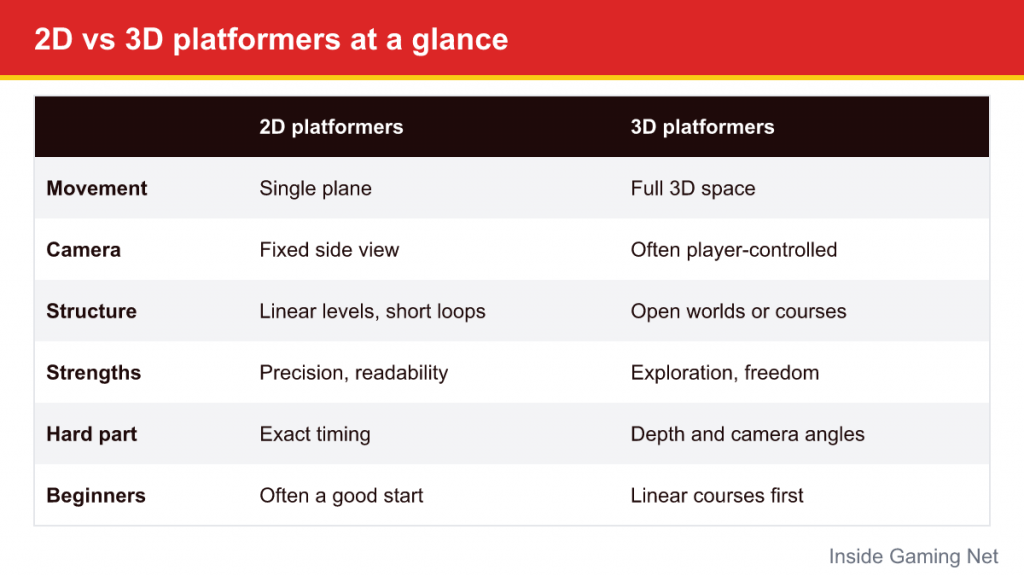
| Aspect | 2D platformers | 3D platformers |
|---|---|---|
| Movement | Single plane (left, right, up, down) | Full 3D space |
| Camera | Fixed side view, usually automatic | Often player-controlled; can be a challenge |
| Typical structure | Linear levels, short loops | Open worlds or linear courses |
| Strengths | Precision, readability, replayability | Exploration, scale, freedom |
| Common difficulty | Exact timing | Judging depth and camera angles |
| Best for beginners | Often yes, especially with assist options | Linear courses yes; open worlds take practice |
What Makes Platforming Feel Good
Great platformers are often praised for their “feel,” a word that describes how responsive and satisfying the controls are. Several design techniques contribute to it:
- Variable jump height: holding the button longer produces a higher jump, giving players fine control.
- Momentum: characters accelerate and decelerate rather than moving at a constant speed, which makes running feel weighty and skillful.
- Forgiving timing tricks: many modern games allow a jump for a split second after walking off a ledge, or remember a jump press made just before landing, so the game matches what the player intended.
- Clear feedback: sounds, animations and effects confirm every action.
These details are invisible when they work well, but players notice immediately when they are missing.
Common Misconceptions About Platformers
- “Platformers are just for kids.” Bright colors are common, but games like Celeste, Cuphead and the hardest Donkey Kong Country stages are among the most demanding experiences in gaming.
- “2D is old-fashioned and 3D is the modern version.” Both styles are thriving. They solve different design problems, and some of the most acclaimed platformers of the last decade are 2D.
- “Any game with jumping is a platformer.” Open-world adventures and shooters often include jumping, but if it is not the core challenge, the game belongs to another genre.
- “Hard platformers are unfair.” Well-designed precision platformers are hard but consistent. Deaths come from misjudged inputs rather than randomness, which is why practice leads to visible improvement.
- “Metroidvanias are a separate genre with no link to platformers.” They grew directly out of platforming, combining jump-based traversal with exploration and ability-based progression.
Which Platformers Should You Try First?
- For a classic 2D start: Super Mario Bros. Wonder, Kirby’s Return to Dream Land Deluxe or Donkey Kong Country Returns HD.
- For a structured 3D start: Super Mario 3D World + Bowser’s Fury or Kirby and the Forgotten Land.
- For open 3D exploration: Super Mario Odyssey or Donkey Kong Bananza on Switch 2.
- For a challenge: Celeste, which offers accessibility options if you need them.
- For exploration and atmosphere: Metroid Dread or Hollow Knight.
To go deeper into specific series, see our guides to Super Mario, Kirby and Metroid.