Super Mario Odyssey Explained: Cappy, Kingdoms and Power Moons
How Super Mario Odyssey works: Cappy's captures, the kingdom structure, Power Moons, Assist Mode, two-player play and what opens up after the credits.

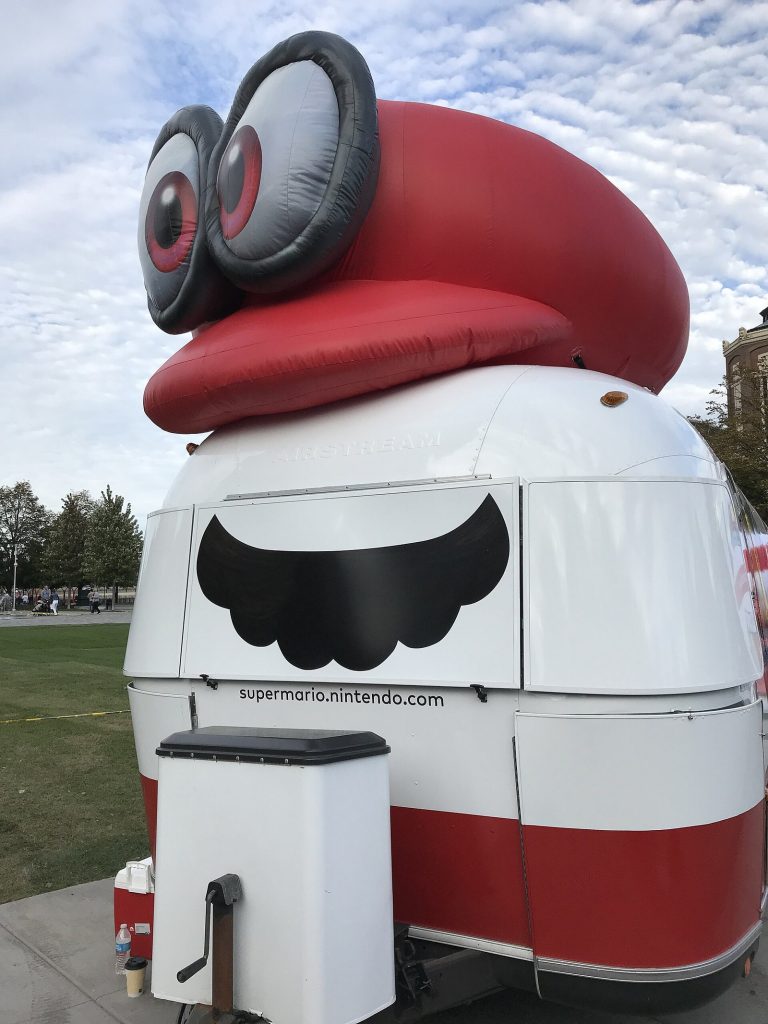
Mario’s hat has never had a bigger job. In Super Mario Odyssey, released on Nintendo Switch on October 27, 2017, the familiar red cap is replaced by Cappy, a living hat who becomes a weapon, a platform and, most importantly, a way to take over almost anything Mario can throw him at. That one idea shapes the entire game, from how levels are built to how many collectibles are hidden in them.
This guide explains how Odyssey is put together: what Cappy does, how the kingdoms and Power Moons work, which assistance options exist, what changes in two-player mode and what waits after the main story. It stays spoiler-light, naming early locations but not the surprises. If you are still deciding whether Odyssey is the right 3D platformer for you, our roundup of the best 3D platformers on Switch and Switch 2 puts it in context.
The Setup in One Paragraph
Bowser has kidnapped Princess Peach and is planning a forced wedding. Along the way he also snatched Tiara, the sister of a hat spirit named Cappy. Mario and Cappy team up, find a hat-shaped airship called the Odyssey, and chase Bowser’s wedding planners across a string of kingdoms far from the Mushroom Kingdom. The Odyssey needs Power Moons to fly, which gives the game its central loop: explore a kingdom, collect moons, power the ship, move on.
The game was developed by Nintendo EPD and directed by Kenta Motokura. Its ESRB rating lists only cartoon violence and comic mischief.
Cappy: Throw, Jump, Capture
Cappy is the core of Odyssey’s controls. Pressing the throw button sends him out like a boomerang, and that simple action branches into several uses.
- Cap Throw: a ranged attack that stuns or defeats enemies, collects coins and hits switches from a distance. You can hold the button to keep Cappy spinning in place for a moment, and motion controls add homing and spin variations.
- Cap Jump: throw Cappy, let him hover, then jump onto him to gain extra height and distance. Chaining this with a dive is the basis of most advanced movement in the game.
- Dive: a mid-air lunge that extends a jump. Combined with the Cap Jump, it lets skilled players cross gaps that look impossible.
- Capture: throw Cappy at a creature or object with no hat (or one he can knock off) and Mario takes it over, complete with Mario’s mustache appearing on whatever he possesses.
Captures are what make Odyssey feel different from every 3D Mario before it. According to the Super Mario Wiki, there are 52 capturable targets in total. Some are classic enemies with new purposes: a Goomba can stack on other Goombas to reach high places, a Bullet Bill becomes a guided missile, and a Cheep Cheep lets Mario breathe underwater indefinitely. Others are more surprising, such as a T-Rex, a tank, a frog with a huge jump, or a power line spark that zips along wires.
Each capture has its own small move set, which is why so many Power Moons involve a “who can I become here?” puzzle rather than pure jumping.
How the Kingdoms Are Built
Odyssey returns to the open, sandbox-style stages of Super Mario 64 and Super Mario Sunshine instead of the linear obstacle courses of Super Mario 3D World. Each kingdom is a single explorable area with a town or landmark at its center, side areas reached through pipes and doors, and dozens of moons hidden in every corner.
The Super Mario Wiki lists 14 kingdoms in the main game. Early ones include:
- Cap Kingdom (Bonneton): Cappy’s foggy hat-shaped home, which works as the tutorial.
- Cascade Kingdom (Fossil Falls): a waterfall-filled area where Mario finds the Odyssey and first tries larger captures.
- Sand Kingdom (Tostarena): a large desert town with icy surprises and plenty of side areas.
- Metro Kingdom (New Donk City): a skyscraper city full of realistic-looking human residents, home to one of the game’s best-known musical moments.
Later kingdoms range from a food-themed volcano to a seaside resort. You do not have to visit them in a fixed order at every point: the story occasionally offers a choice of two destinations, and once a kingdom is unlocked you can return whenever you like.
Two other features help each kingdom stand out. Every kingdom has its own type of regional purple coin, shaped to match the location, which is spent at the local Crazy Cap shop on themed outfits and souvenirs. And each kingdom contains 8-bit sections, where Mario walks into a wall and becomes a flat, retro sprite in a short 2D side-scrolling segment inspired by the original Super Mario Bros.
Power Moons: The Collectible That Drives Everything
Power Moons replace the Power Stars of earlier 3D Marios, and there are far more of them. In Super Mario 64 a course held a handful of stars; in Odyssey a single kingdom can hold dozens of moons. The Super Mario Wiki notes that collecting all 880 Power Moons turns the Odyssey’s sail gold.
Moons come from many sources:
- Story objectives and boss fights, which often award a Multi Moon, a cluster that counts as three moons.
- Platforming challenges, often hidden behind pipes or doors.
- Small puzzles: ground-pounding a suspicious spot, finding a hidden object, completing a race or a jump-rope minigame.
- Collecting five Moon Shards or planting seeds and returning later.
- Talking to residents and fulfilling simple requests.
- Buying one from each kingdom’s Crazy Cap shop with regular coins.
Each kingdom requires a certain number of moons before the Odyssey can leave, but the threshold is usually far below the total available. Casual players can grab the obvious moons and keep the story moving, while completionists can stay and comb every corner.
If you are stuck, there are built-in hint systems. A parrot named Talkatoo tells you the names of moons you have not found yet, which often doubles as a clue. Hint Toad marks a moon’s location on the map in exchange for coins, and scanning an amiibo can do the same.
No Lives, Just Coins
Odyssey drops the traditional lives system. Mario has a three-segment health meter, and there are no 1-Up Mushrooms or Game Overs. When he loses all his health or falls into a pit, he restarts from the last checkpoint flag and loses 10 coins. Picking up a Life-Up Heart temporarily raises his maximum health, which is useful for tougher sections.
Activated checkpoint flags double as fast-travel points, so failure costs a little time and a few coins, never your progress.
Assist Mode and Other Help
For younger or newer players, Odyssey includes an Assist Mode that can be switched on from the options. According to the Super Mario Wiki, it changes several things at once:
- Mario gets six health segments instead of three, and standing still slowly restores health.
- Falling into a pit or touching lava or poison does not end the attempt; a bubble carries Mario back to safety at the cost of one health segment.
- Arrows on the ground point toward the current objective.
- When you need more moons to progress, the guidance points you toward hints and nearby moons.
Assist Mode does not lock you out of anything; it simply removes the harshest punishments and adds signposting. Paired with the coin-based failure system, it makes Odyssey one of the more approachable 3D platformers on the system.
Two Players: Mario and Cappy
Odyssey supports a simple two-player option. As Nintendo’s product page describes it, Player 1 controls Mario and Player 2 controls Cappy using a second Joy-Con. The Cappy player can fly around independently to attack enemies and grab coins, while staying within a limited range of Mario. It works best as a light way to let a sibling or parent help out rather than a full co-op adventure, since Mario’s player still handles all the platforming.
On Nintendo Switch 2, a free update released around the console’s June 2025 launch improves resolution and image quality, adds HDR support and enables GameShare, so the Cappy role can be shared with another system locally or online via GameChat. For more on how Switch 1 games behave on the newer console, see our guide to Switch 2 backward compatibility and Switch 2 Edition games.
Outside the main loop, Crazy Cap outfits are mostly cosmetic (a few doors only open if Mario is dressed for the occasion), a single-player Snapshot Mode lets you pose the camera and add filters, and a free February 2018 update added Luigi’s Balloon World, a hide-and-seek mode built around balloons hidden by other players.
What Opens Up After the Credits
Finishing the story is roughly the midpoint of Odyssey for many players. Without spoiling specifics, the post-game:
- Opens a new area themed around a very familiar Nintendo location, including a nod to Super Mario 64.
- Adds new Power Moons to earlier kingdoms, often in the form of harder challenges and returning characters.
- Lets you buy additional moons at Crazy Cap shops, which count toward your overall total.
- Unlocks two final challenges on the moon that require large numbers of Power Moons: the Super Mario Wiki notes that the first needs 250 and the second 500. One is built around boss battles, the other is a long platforming gauntlet that tests nearly every skill and capture in the game.
That final gauntlet is entirely optional; players who just want the story can stop at the credits.
How Odyssey Compares with Earlier 3D Marios
Odyssey sits at a crossroads in the 3D Mario family tree. The table below summarizes the key differences, and our Super Mario games guide explains how the wider series fits together.
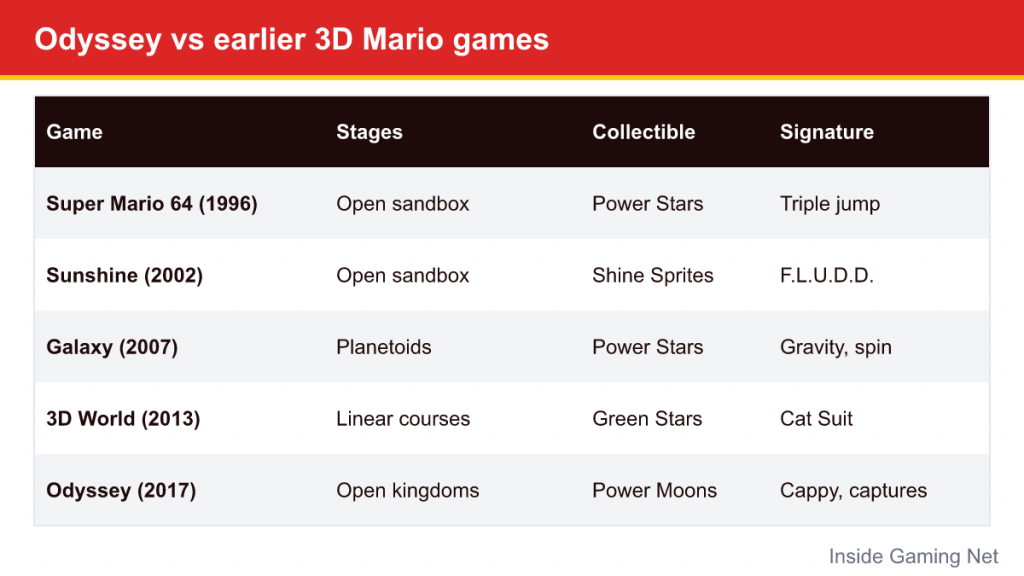
| Game | Stage style | Main collectible | Signature mechanic |
|---|---|---|---|
| Super Mario 64 (1996) | Open sandbox courses | Power Stars | Analog movement, triple jump |
| Super Mario Sunshine (2002) | Open sandbox courses | Shine Sprites | F.L.U.D.D. water pack |
| Super Mario Galaxy (2007) | Small planetoids, linear routes | Power Stars | Gravity and spin attack |
| Super Mario 3D World (2013) | Linear obstacle courses | Green Stars, flag pole | Cat Suit, multiplayer |
| Super Mario Odyssey (2017) | Open sandbox kingdoms | Power Moons | Cappy and captures |
Compared with 64 and Sunshine, Odyssey keeps the open structure but makes collectibles much denser, with no mission menu to pick from. Compared with Galaxy and 3D World, it trades linear paths for freedom while hiding their style of short, focused challenges behind pipes and doors.
The capture mechanic is its biggest contribution. Earlier games gave Mario new tools (a water pack, a spin, a cat suit); Odyssey instead lets him borrow the abilities of the world around him. That variety is a big reason the game holds a 97 Metascore according to Wikipedia, and why it won Best Family Game at The Game Awards 2017.
Who Odyssey Suits Best
Odyssey is a strong fit for players who enjoy exploring and poking at things to see what happens. The density of moons rewards curiosity more than precision, at least until the post-game. Younger children may need help with the camera and some of the trickier jumps, but Assist Mode and the lack of lives soften the edges considerably. Reading demands are light, mostly limited to short dialogue and hints.
Odyssey remains, as of October 2026, one of the most complete examples of what a 3D Mario can be, and it plays even better on Switch 2 thanks to the free update.