Platformer Movement Explained: Jumps, Momentum and Coyote Time
Why some platformers feel great to control: variable jumps, momentum, wall jumps, ground pounds, coyote time and input buffering explained with examples.
Ask players why they love a platformer and they will often say something vague: it “feels good,” the controls are “tight,” Mario “just moves right.” That feeling is not magic. It comes from dozens of small, deliberate decisions about how a character accelerates, how high it jumps, how gravity pulls it back down and how much the game quietly forgives near-misses. This explainer breaks down the most important movement mechanics, what each one does, and where you have seen it in well-known games.
If you are new to the genre’s sub-types, our explainer on 2D vs 3D platformers is a useful companion. Here the focus is narrower: the physics and tricks behind a single jump.
The Jump Arc: Height, Distance and Gravity
Every platformer starts with a jump, and every jump is a curve. The simplest version gives the character an upward speed when the button is pressed, then lets gravity slow it down, stop it and pull it back to the ground. Real-world gravity would make that curve a perfect parabola, but most good platformers do not use realistic physics, because realistic jumps feel floaty and hard to judge.
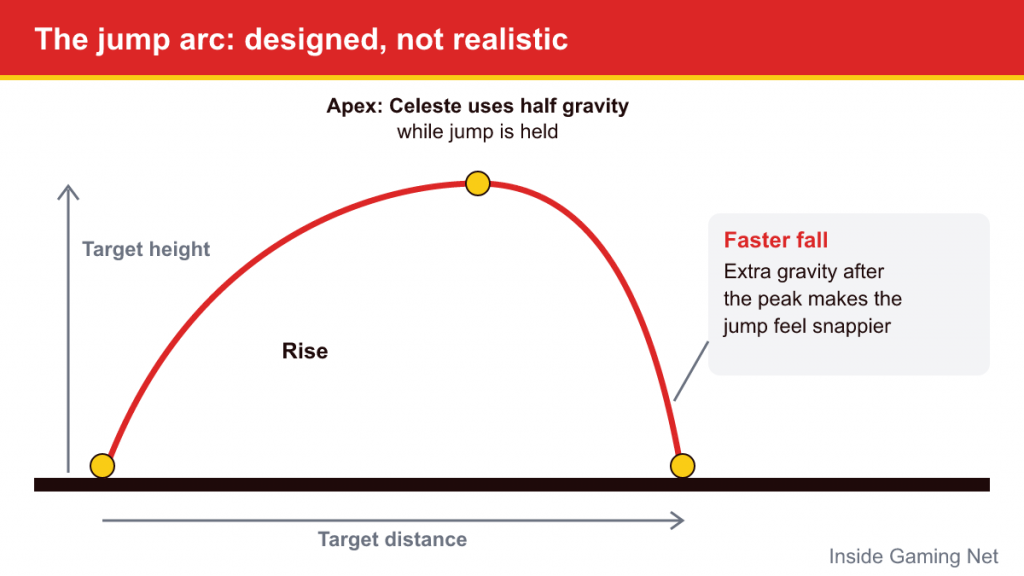
Designers usually think in terms of the results they want: how high should the character rise, and how far horizontally should a running jump carry? In his GDC 2016 talk “Math for Game Programmers: Building a Better Jump,” developer Kyle Pittman of Minor Key Games described exactly this approach: start from a desired jump height and distance, then derive the gravity and initial velocity that produce it, rather than tweaking physics numbers blindly until something feels right. The same talk covers two common refinements that appear in many games:
- Faster falling. Increasing gravity after the peak of the jump makes the descent quicker than the ascent. The jump feels snappier and less like a balloon drifting down.
- Variable height. Letting the jump’s height depend on how long the button is held, covered in the next section.
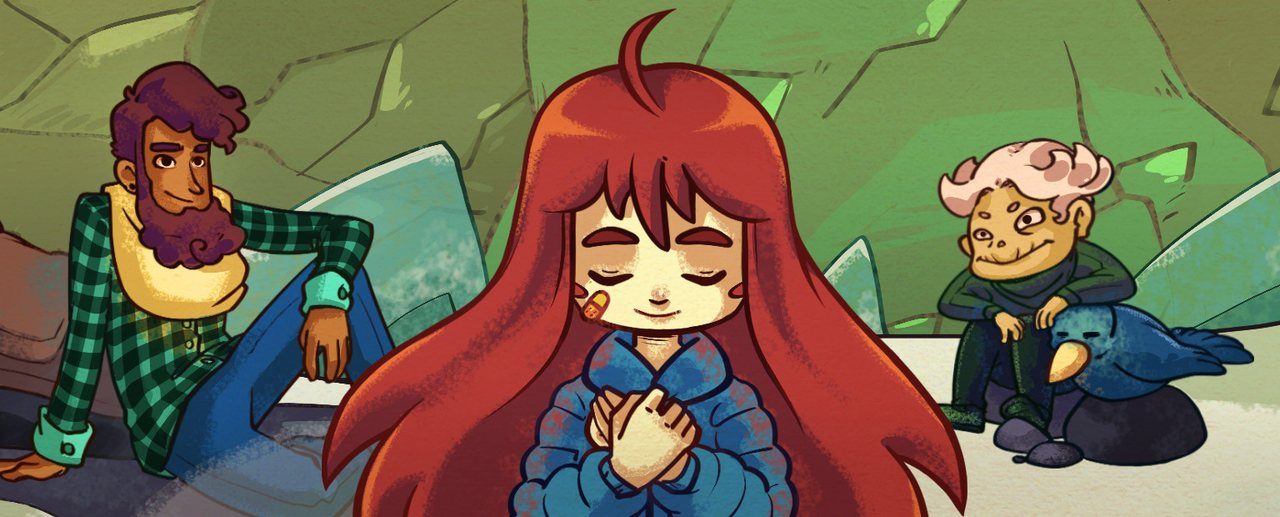
The opposite trick also exists. Maddy Thorson, creator of Celeste, has written that in that game, holding the jump button applies half gravity at the top of the jump. The character hangs at the apex slightly longer, giving the player a moment to line up the landing. It is a tiny change, but it is one reason Celeste’s movement reads as precise rather than rushed.
Variable Jump Height
In Super Mario Bros. and nearly every Mario game since, a quick tap of the button produces a short hop and holding it produces a full jump. This is variable jump height, and it might be the single most important feature separating a controllable platformer from a frustrating one.
Without it, every jump is identical. With it, the player decides mid-air how much of the jump to use: hopping over a low enemy without hitting a ceiling of spikes, or reaching a nearby ledge without overshooting.
The common way to implement it is simple: when the player releases the button while still rising, the game cuts the upward speed or increases gravity, so the jump ends early. Different games tune this differently. Some cut the jump sharply on release, others let it taper off. Players rarely notice the details, but they notice immediately when it is missing.
Momentum and Acceleration
How a character starts and stops moving shapes a platformer’s personality as much as the jump does.
Instant versus gradual movement
Some games give characters near-instant top speed and near-instant stopping. This feels precise and is common in games built around exact positioning. Others make characters accelerate over a short distance and skid when they turn around. Mario is the classic example of the second style: in the original Super Mario Bros., Mario builds speed as he runs, and his running speed affects how far he jumps. Momentum rewards planning, because a long gap needs a run-up.
Momentum as the main mechanic
The Sonic the Hedgehog games push momentum to the center of the design: slopes, loops and rolling all depend on speed carried from one section to the next. On the other end, Donkey Kong’s games give him a heavier, more committed feel, with rolls that you can jump out of to extend a jump, a trick covered in our Donkey Kong series guide.
Air control
Air control is how much the player can steer after leaving the ground. A real person cannot change direction mid-air, but almost every platformer allows it. Generous air control makes a game forgiving and expressive; limited air control makes each jump a commitment, which can feel weighty or stiff depending on the level design around it.
Extra Jumps and Wall Movement
Once the basic jump feels right, designers often add more ways to move vertically.
Double jumps
A double jump lets the character jump again in mid-air. It gives the player a second chance to correct a mistimed jump and lets designers build taller, more vertical spaces. In metroidvanias, a double jump is often an unlockable ability that opens previously unreachable areas, which is why it shows up so often as a reward rather than a starting move. Hollow Knight’s Monarch Wings work exactly this way.
Not every “double jump” means the same thing. In Super Mario 64, the double and triple jumps are sequential: you press jump again right as Mario lands, and each jump goes higher. That design rewards rhythm rather than giving a free mid-air reset.
Wall jumps
Wall jumps let a character kick off a vertical surface. Super Mario 64’s wall kick, Super Metroid’s wall jump and Celeste’s wall climb and jump are all variations. Wall jumps change level design dramatically: a narrow vertical shaft becomes a path instead of a dead end.
They are also a place where games quietly help the player. Thorson has explained that in Celeste, a normal wall jump works from 2 pixels away from the wall, about a quarter of a tile in a game that runs at a 320×180 resolution. The player does not need to be touching the wall exactly; being almost there is enough.
Ground pounds, dives and air dashes
A ground pound slams the character straight down, usually to break blocks, press switches or hit enemies below. It also acts as a precision tool: in many 3D Mario games, a ground pound stops horizontal motion and drops you onto a small target. Dives and air dashes do the opposite, adding horizontal reach. Celeste is built around a single air dash that refreshes on landing, and Super Mario Odyssey lets Mario throw Cappy and bounce off him mid-air for extra distance.
Coyote Time: The Invisible Ledge
Coyote time is named after Wile E. Coyote, the Looney Tunes character who runs off cliffs and hangs in the air for a moment before falling. In games, it means the player can still jump for a short time after walking off a ledge.
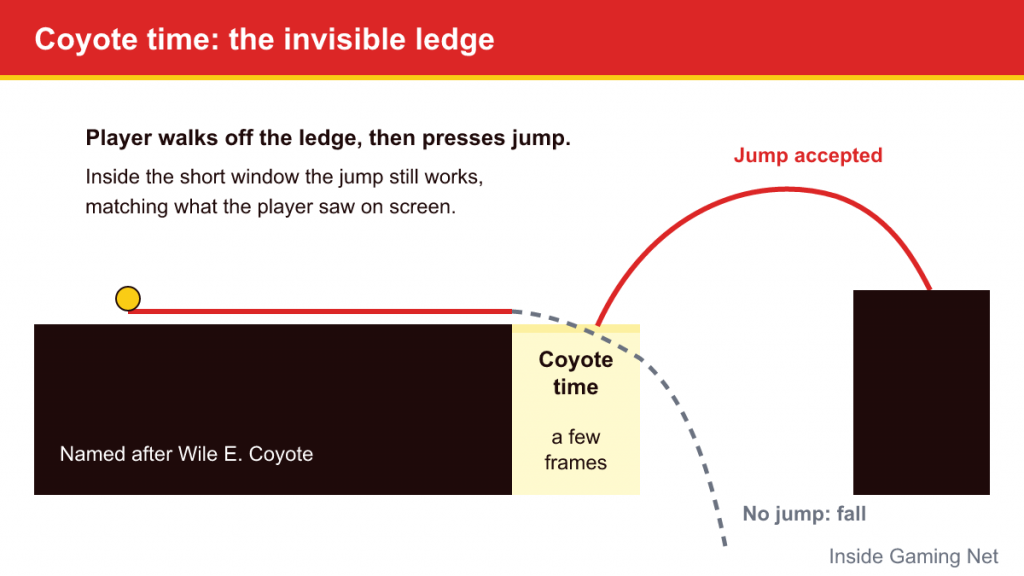
Why is this needed? Human reaction time and screen refresh mean players often press jump a fraction of a second after the character has technically left the platform. In a game without coyote time, that press does nothing, and the character falls. The player is certain they pressed jump on the edge, and they are almost right. The result feels unfair even though the game is technically correct.
Coyote time makes the game agree with the player’s perception rather than with strict physics. The window is very short, typically a handful of frames, so it does not change what the level asks of you. It only removes the frustration of losing to a margin you could not possibly see. Thorson has been clear that the Celeste team did not invent the technique, which has been used in many platformers, but described it as an important part of how the game feels.
Input Buffering and Other Forgiveness Tricks
Input buffering solves the opposite timing problem. If the player presses jump just before landing, a strict game would ignore the press because the character is still in the air. With buffering, the game remembers the press for a short window and performs the jump on the exact frame the character lands. In Celeste, Thorson explains, pressing and holding jump shortly before landing makes Madeline jump the moment she touches down.
Celeste’s design notes list several other quiet helpers that show how deep this goes:
- Corner correction. If the character bonks her head on a corner while jumping, the game nudges her sideways around it instead of stopping the jump dead.
- Dash corner correction. A sideways dash that clips the edge of a ledge pops the character up onto it.
- Momentum from moving platforms. Jumping off a fast-moving platform adds its speed to the jump, and the game keeps that boost for a few frames after the platform stops, so slightly late jumps still benefit.
- Stamina refunds. If a player jumps straight up a wall and then presses away from it shortly after, the game refunds the stamina and turns it into a normal wall jump.
None of these make Celeste easy; it is famous for its difficulty. What they do is make failure feel like the player’s fault rather than the controller’s. That distinction is the difference between a hard game people finish and a hard game people quit.
How the Pieces Fit Together
No mechanic works alone. The table below summarizes what each one solves and where you can see it.
| Mechanic | What it does | Well-known examples |
|---|---|---|
| Variable jump height | Tap for a hop, hold for a full jump | Super Mario Bros., most modern platformers |
| Faster fall / apex hang | Shapes the jump curve for readability | Celeste (half gravity at the peak) |
| Momentum | Speed builds over time and carries into jumps | Super Mario Bros., Sonic the Hedgehog |
| Double jump | Second jump in mid-air | Hollow Knight (unlockable) |
| Sequential jumps | Higher jumps for well-timed repeats | Super Mario 64 triple jump |
| Wall jump | Kick off vertical surfaces | Super Mario 64, Super Metroid, Celeste |
| Ground pound | Drop straight down with force | 3D Mario games |
| Coyote time | Jump briefly after leaving a ledge | Celeste and many others |
| Input buffering | Early jump presses still count on landing | Celeste and many others |
The best platformers tune all of these against their level design. A game with huge air control needs tighter, more dangerous spaces to stay interesting. A game with heavy momentum needs long runways and clear sight lines. A game built on instant respawns, like Celeste or Super Meat Boy, can afford brutal challenges because the forgiveness systems make each attempt feel fair.
Spotting These Mechanics When You Play
Once you know these ideas, you start noticing them. Try tapping and holding jump in different games to see how sharply the jump cuts off. Walk off a ledge and press jump a moment late; in many modern platformers, you will still jump. Press jump just before landing and see whether the game catches it. Compare how quickly a character stops when you let go of the stick.
When a platformer feels “off” despite good levels, one of these systems is often missing or mistuned. For a list of games where the tuning is widely considered excellent, see our pick of the best 2D platformers on Switch and Switch 2. Every game on it treats the humble jump as the most important thing in the world, and that is exactly the right instinct.