Super Mario Bros. Wonder Explained: Wonder Flowers, Badges and Characters
A clear breakdown of Super Mario Bros. Wonder: Wonder Flowers, Badges, new power-ups, character differences, online features and the Switch 2 Edition.
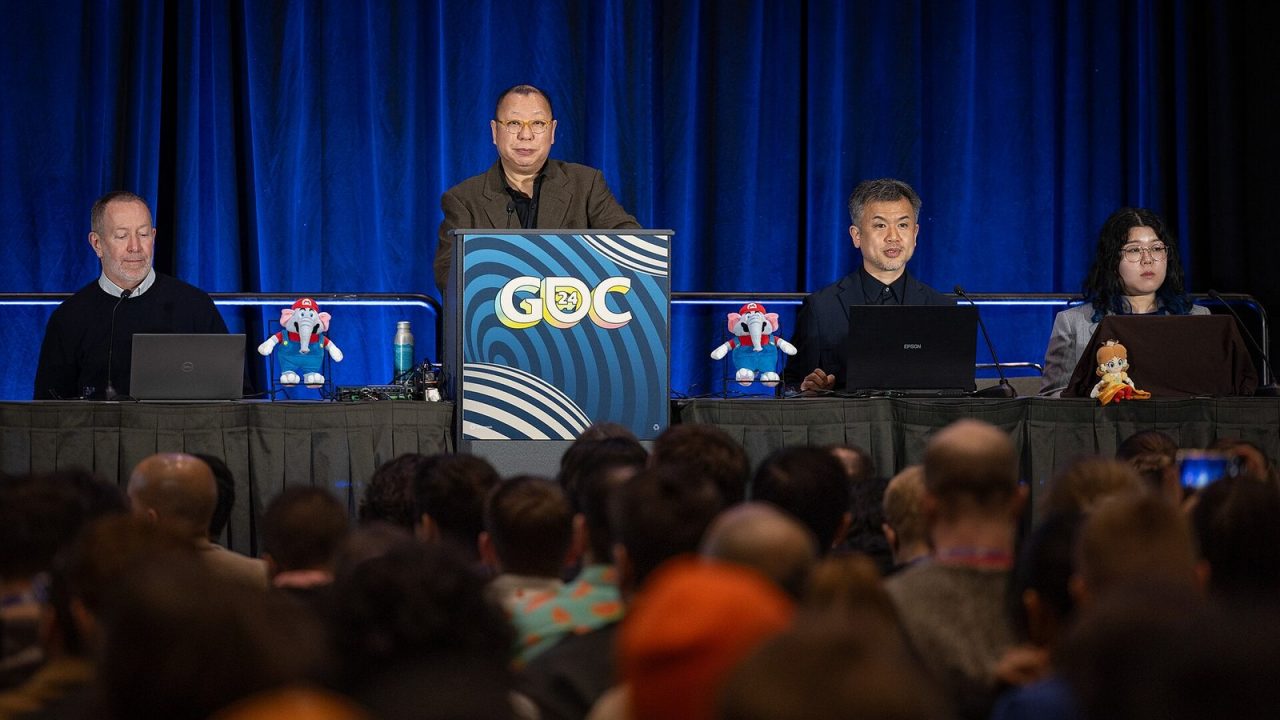
For more than a decade, 2D Mario followed a familiar template under the “New Super Mario Bros.” banner. Super Mario Bros. Wonder, released on Nintendo Switch on October 20, 2023, broke that pattern. It kept the side-scrolling run-and-jump core but added a layer of unpredictability: touch a special flower and the level itself may transform into something completely different.
This explainer walks through the systems that make Wonder tick, from Wonder Flowers and Badges to the new power-ups, how the playable characters differ, what the online features do and what the 2026 Switch 2 Edition adds. It is spoiler-light: the surprises inside individual Wonder Flowers are part of the fun, so they are described only in general terms.
Where Wonder Fits in the Series
Wonder is a mainline 2D Mario, the direct successor to games like Super Mario World and the New Super Mario Bros. series. It was directed by Shiro Mouri and produced by Takashi Tezuka, a veteran of the original Super Mario Bros. The setting moves away from the Mushroom Kingdom to the Flower Kingdom, where Prince Florian has invited Mario and friends. Bowser, predictably, crashes the visit by stealing a Wonder Flower and merging with Florian’s castle.
The art style also changed. Characters are more expressive, with new animations for small actions like squeezing through pipes or reacting to enemies. Mario has a new voice actor, Kevin Afghani, after Charles Martinet stepped back from the role. If you want to see how Wonder compares with other side-scrollers on the system, our list of the best 2D platformers on Switch and Switch 2 covers the wider field.
Wonder Flowers and Wonder Seeds
Almost every course contains a hidden Wonder Flower. Touching it triggers a Wonder effect that temporarily changes the rules of the stage. Depending on the course, that might mean:
- Pipes coming to life and moving like caterpillars.
- A stampede of enemies charging across the screen.
- The camera perspective shifting.
- Mario’s own form or abilities changing in unexpected ways.
- The music and background turning the level into something closer to a musical number.
Each Wonder effect is self-contained. It ends when you grab the Wonder Seed waiting at the end of the sequence, or if you leave the affected area. Because every effect is designed for its specific course, very few repeat, which is why players often describe each level as a small surprise.
Wonder Seeds are the main progression collectible. Each course has at least one from reaching the goal, and many have a second from the Wonder Flower sequence or a hidden route. Seeds open up new paths on the world map and lead toward the larger Royal Seeds that are needed to reach Bowser.
Alongside seeds, courses hold three large 10-flower coins, which are the classic completionist challenge, and regular flower coins, which act as the currency for shops run by the Poplins, the Flower Kingdom’s small residents. Courses on the map display a star-based difficulty rating, so you always know roughly what you are walking into.
Another small but welcome addition is the Talking Flowers. These chatty plants pop up throughout courses with short comments, often hinting that something interesting is nearby. They are purely flavor, but they help give the game its playful personality.
Badges: Choose One Ability per Course
Badges are Wonder’s way of letting players tune the game. Before entering a course, you can equip one badge, and it applies for that whole run. According to the Super Mario Wiki, the base game contains 24 badges in three categories:
| Category | What it does | Examples |
|---|---|---|
| Action | Adds a new move | Parachute Cap (slow descent), Wall-Climb Jump, Dolphin Kick, Grappling Vine, Floating High Jump |
| Boost | Gives a passive benefit | Safety Bounce (bounce out of a pit or lava once), Auto Super Mushroom, Add ! Blocks, Coin Magnet |
| Expert | Changes play in a demanding way | Jet Run (constant high speed), Spring Feet, Invisibility |
Badges are earned through dedicated Badge Challenge courses, bought from Poplin shops with flower coins, or found as rewards in specific courses. They are entirely optional: you can play with none equipped for a classic experience, or lean on helpful ones like Safety Bounce while learning. Some hidden areas are easier to reach with a particular badge, which encourages experimenting on replays.
The one-badge limit matters. It keeps the game balanced and turns badge choice into a small decision before each course: do you want the extra safety of a Boost badge, or the movement freedom of an Action badge?
Power-Ups Old and New
Classic items like the Super Mushroom, Fire Flower and Super Star return, but Wonder adds three headline power-ups:
- Elephant Fruit: turns the character into a large elephant version of themselves. The trunk can swat enemies and break blocks, and it can spray water carried from pools to interact with certain plants. Elephant forms are bigger, which takes some getting used to in tight spaces.
- Bubble Flower: fires bubbles that trap enemies and turn them into coins. Bubbles can also be bounced on, which opens creative routes across gaps.
- Drill Mushroom: gives a drill hat that lets the character burrow into the ground or ceilings and attack enemies from below or above.
If you want a deeper look at why the jumps and momentum in games like this feel so precise, our explainer on platformer movement mechanics covers the underlying design ideas.
Characters: Who Plays How
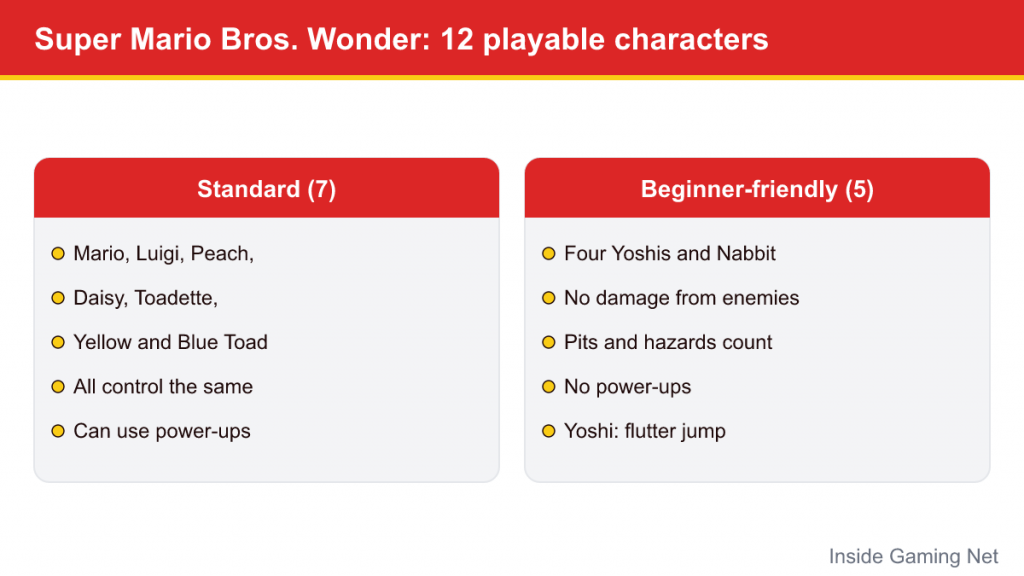
The base game has 12 playable characters: Mario, Luigi, Peach, Daisy, Yellow Toad, Blue Toad, Toadette, Nabbit and four colors of Yoshi. They fall into two groups.
Standard characters
Mario, Luigi, Peach, Daisy, both Toads and Toadette all control the same way. There are no hidden differences in jump height or speed, so choosing one is purely about appearance and preference. This is a deliberate change from some older games where characters had different physics.
Beginner-friendly characters: Yoshi and Nabbit
The four Yoshis and Nabbit are designed for newer or younger players because they do not take damage from enemies. They can still lose a life by falling into a pit or touching hazards like lava or poison, so they are not invincible, but ordinary enemy contact will not hurt them.
- Yoshi has a flutter jump to extend jumps, can eat many enemies, and can carry another player on its back in multiplayer. However, Yoshis cannot use power-ups.
- Nabbit also cannot use power-ups; according to the Super Mario Wiki, he turns them into flower coins instead. Unlike the Yoshis, he does not flinch or get knocked back when hit, which makes him the most forgiving option.
This split is one of Wonder’s smartest decisions for families. A child can pick Yoshi or Nabbit and enjoy the levels with much less frustration, while a more experienced player uses a standard character. Nobody is forced into a separate “easy mode.”
Online Features Without the Chaos
Local multiplayer supports up to four players on one system, but Wonder’s online design takes a different approach from traditional co-op. When playing online (which requires a Nintendo Switch Online membership), you see translucent “shadows” of other players moving through the same course in real time. They cannot bump into you or steal your power-ups, so they never get in the way.
Instead, the online systems are built so players can only help each other:
- Players can place standees (cardboard cutouts of their character) in a course. If you lose a life, you can return as a ghost and touch a standee to revive on the spot.
- If you fall and another online player is nearby, you can float back to them as a ghost and revive.
- Seeing other players’ shadows head toward a hidden path is often a hint that something is worth finding.
The overall effect is a sense of company without pressure, which is unusual for an online mode and works well for younger players.
The Switch 2 Edition: What It Adds
Super Mario Bros. Wonder – Nintendo Switch 2 Edition + Meetup in Bellabel Park launched on March 26, 2026. It is sold as a new release, and existing owners of the Switch version can buy an upgrade pack rather than the whole game again. As of October 2026, the additions include:
- Rosalina: playable for the first time in the game, in both the main adventure and the new content.
- Luma: a second-player helper character available when at least two people are playing. Luma can fly around, collect coins and spin-attack enemies, and can be controlled with Joy-Con 2 mouse controls.
- The Koopalings: all seven appear after stealing treasure from Bellabel Park and scattering across the Flower Kingdom. Finding them leads to new boss courses.
- Bellabel Park: a new hub with a Local Multiplayer Plaza of 17 co-op and competitive attractions for up to four players on one system (GameShare also supported), and a Game Room Plaza with six attractions, including ghost races for up to eight players locally or twelve online.
- Toad Brigade Training Camp: challenges that revisit main-adventure courses with goals like collecting every coin against the clock, earning patches and rank-ups.
- Assist Mode: a new option aimed at newer and younger players that protects against damage regardless of character and recovers you from unexpected falls without losing a life.
- New badges and a new power-up: the Super Mario Wiki documents additional badges, including combined “dual” badges, and a Flower Pot power-up.
Assist Mode is arguably the biggest change for families. In the original release, only Yoshi and Nabbit offered damage protection, which meant giving up power-ups. With the Switch 2 Edition, a beginner can pick any character, including Mario or the new Rosalina, and still enjoy a safety net. Most of Bellabel Park, on the other hand, is built around multiplayer, so solo players should treat it as a bonus rather than a major reason to upgrade.
For more on how upgrade packs and Switch 2 Editions work in general, see our guide to Switch 2 backward compatibility and Switch 2 Edition games.
Is Wonder the Right 2D Mario to Start With?
For most players, yes. Wonder is approachable in its early worlds, gradually ramps up toward challenging optional courses, and gives players tools like badges and beginner characters to manage difficulty. Its reading demands are light, and the Wonder effects reward curiosity more than memorization.
The game has also been a commercial success. According to Wikipedia, citing Nintendo’s figures, it sold 4.3 million copies in its first two weeks and reached 17.15 million by March 31, 2026, making it the fastest-selling Super Mario game.
A few practical tips for newcomers:
- Equip Safety Bounce or Parachute Cap while learning; they forgive many common mistakes.
- If a younger child is playing, start them on Yoshi or Nabbit, or turn on Assist Mode in the Switch 2 Edition.
- Do not worry about collecting every 10-flower coin on the first pass. Returning later with a different badge is part of the design.
- Explore anything that looks odd: hidden Wonder Flowers and secret exits are often tucked just off the main path.
Players who love tough challenges will find that the later optional courses push precision much further than the opening hours suggest. Those who just want a cheerful, inventive side-scroller can stick to the main path and still see plenty of surprises.