

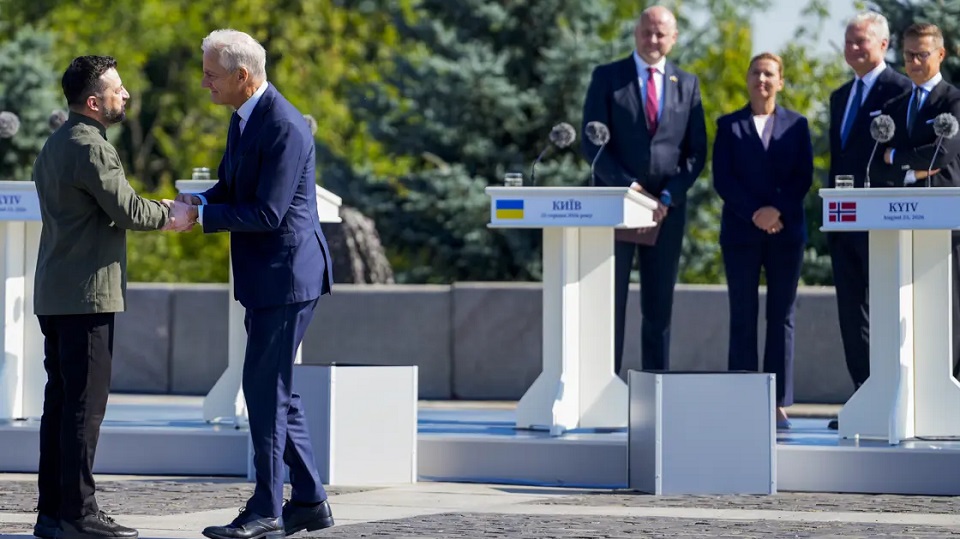
Norway has announced a significant expansion of its commitment to Ukraine, pledging approximately $9 billion in support through the Nansen Program. The Norwegian government emphasized that supporting and rebuilding Ukraine is crucial for maintaining European security, underscoring the Nordic nation’s continued dedication to standing with Kyiv against Russian aggression. This substantial financial commitment positions Norway as one of the leading per-capita contributors to Ukraine’s defense and reconstruction efforts among Western nations.
The announcement comes at a critical time when Ukraine continues to face ongoing military pressure and requires sustained international support to maintain its defensive capabilities while simultaneously beginning the massive task of rebuilding damaged infrastructure. Norwegian officials have stressed that this investment is not merely humanitarian but represents a strategic imperative for the stability of the entire European continent.
The Nansen Program: A Historic Commitment
The Nansen Program, named after the legendary Norwegian explorer, scientist, and humanitarian Fridtjof Nansen, carries deep symbolic significance. Nansen was awarded the Nobel Peace Prize in 1922 for his work helping refugees and displaced persons following World War I, establishing the famous “Nansen passport” for stateless people. By naming this support program after such an iconic figure, Norway is drawing a direct line between its historical humanitarian legacy and its current commitment to Ukraine.
The program encompasses multiple forms of assistance, including military equipment, financial aid, humanitarian support, and funding for reconstruction projects. Norwegian authorities have indicated that the funding will be distributed over several years, providing Ukraine with a predictable and stable source of support that allows for long-term planning. This multi-year approach reflects lessons learned from other international aid programs, where consistent funding proves more effective than sporadic large donations.
Strategic Importance for European Security
Norwegian officials have repeatedly emphasized that Ukraine’s fight is intrinsically linked to broader European security concerns. As a NATO member sharing a border with Russia, Norway has particular awareness of the geopolitical dynamics at play. The country’s defense establishment views Russian aggression against Ukraine as a potential precedent that could threaten the rules-based international order that has maintained peace in Europe for decades.
This perspective is shared across the Norwegian political spectrum, with broad parliamentary support for Ukraine assistance. Defense analysts note that Norway’s substantial oil and gas revenues have enabled the country to commit resources at levels that would be challenging for many other nations of similar population size. With approximately 5.5 million residents, Norway’s per-capita contribution to Ukraine ranks among the highest in the world, reflecting both its economic capacity and its strategic assessment of the conflict’s importance.
International Context and Coalition Building
Norway’s announcement adds to a growing wave of long-term commitments from Western nations seeking to assure Ukraine of sustained support. The Biden administration in the United States, along with the United Kingdom, Germany, and other European allies, have all announced multi-year assistance packages in recent months. This coordination reflects an effort to demonstrate to both Ukraine and Russia that Western support will not waver despite the conflict’s prolonged nature.
Economic experts note that Ukraine’s reconstruction needs are estimated to exceed $400 billion, making sustained international commitment essential. The Norwegian contribution, while significant, represents part of a larger international effort that will need to continue for years, potentially decades, to fully address the damage caused by the ongoing conflict. International financial institutions, including the World Bank and European Investment Bank, are also playing crucial roles in coordinating reconstruction planning and financing.
Expert Opinion: Norway’s $9 billion commitment through the Nansen Program represents a strategic calculation that investing in Ukraine’s defense and reconstruction now is far less costly than allowing Russian aggression to succeed and potentially destabilize the broader European security architecture. As energy revenues continue to provide fiscal flexibility, Nordic nations like Norway are likely to maintain elevated support levels, potentially encouraging other wealthy democracies to increase their commitments proportionally. This sustained, predictable funding model may prove more valuable to Ukraine’s long-term resilience than larger but uncertain aid packages.